


Please use the drop-downs in the table below to explore the full planned agenda for the conference.
Please note that the agenda may be subject to change.
The 2024 Annual student Conference will be held on Tuesday, November 26th at Future Inns, Bristol. The conference brings together social science researchers from across our consortium.
10:00- 10:45
Registration and refreshments
10:45- 11:30
Plenary session
Keynote
Dr Morgana Lizzio-Wilson:
Achieving and maintaining progress social change
11:45- 12:45
Click on each room to see more information about the presenters.
Student Presentations
Darja Wischerath:
Down the Rabbit Hole: An Ethnographic Exploration of Conspiracy Narratives on YouTube
The proliferation of conspiracy theories within online communities has tangible offline consequences, both on an individual and collective level. Douglas et al. (2017) proposed that belief in conspiracy narratives is driven by unfulfilled psychological needs such as existential threat, epistemic motives, and social motives. Whilst this theory has found support in experimental studies, it has not been explored in an ecologically valid setting. Given the importance of social media in spreading conspiracy narratives, it is vital to validate theories of conspiracy belief in online data.
We sampled conspiracy YouTube videos through a 1-month ethnography, exploring how conspiracy narratives address grievances and psychological needs as set out by Douglas et al. We performed an LDA topic model on n = 102 videos and n = 455,738 comments and qualitatively examined n = 24 videos and n = 1,200 comments through an abductive approach. We validate and extend Douglas et al.’s model, highlighting how conspiracy narratives address and amplify grievances and psychological needs in both official and community generated discourse.
Janusz Swierczynski:
Creepy or Crime Preventing? The perceived costs and benefits of smart home security technology
Video-enabled smart security devices such as video doorbells or security cameras are increasingly being purchased with the aim of improving physical security in and outside people’s homes, yet they also expose people to privacy risks. This study utilises a unique dataset consisting of more than 5000 amazon reviews to explore what factors people that people who have adopted these devices considered important when choosing to buy this technology, and the role that privacy and security played in this decision. Early findings indicate that privacy does not feature as an important consideration in many of the reviews in our dataset, and instead adopters prioritise security benefits and more conventional factors e.g., the product’s technical abilities. This work takes a topic modelling approach using BERTopic to make sense of this large textual dataset. Digital methods are a relatively novel methodology for utilising the Internet as a source of data (rather than an object of study) allowing us to answer research questions about society through the medium of the Internet. This talk has two objectives 1) to present work-in-progress and seek feedback from fellow social scientists, and 2) reflect on using computational methods for social science research.
Jon Ablett:
A history of the interrelationship between the veteran and welfare
The unstable, transient and ambivalent status of veterans, who are simultaneously hero and threat, saviour and liability, vulnerable and competent, has permeated the history of welfare provision and continues to cause complexities today. This paper will reflect upon the contradictions and contestations in welfare provision for veterans and the longstanding problems created for the State through the existence of trained but demobbed soldiers. This will be achieved through chronologically investigating many of the key legal welfare developments in England. From some of the oldest welfare laws such as the Elizabethan licenses to beg for soldiers, through the Poor Laws and Vagrancy Acts, to finally investigating the role veterans played in the development of the ‘modern’ welfare state in the 20th century.
This paper will also discuss contemporary welfare laws and policies, which Deborah Cowen claims has seen a revised societal militarism and increased neoliberal welfare policies dominate our welfare, and potentially homelessness, laws. Indeed, while this paper differs from her work in key aspects, there will be a discussion of Cowen’s belief that the soldier is an exceptional citizen, who had a large impact upon the development of the welfare state. This paper will ultimately examine the extent to which welfare laws, particularly as they relate to homelessness, were shaped by veterans and how these laws in turn may have shaped veterans through the narratives they perpetuated.
Shadma Ahmed:
Reflections from fieldwork on activism and resistance among young Muslim women in Mumbai, India
My doctoral research seeks to understand Muslim women university students’ journeys into activism as a window into the process of becoming activists. It is based in Mumbai, India and uses feminist ethnography. It particularly focuses on their personal histories, motivations, strategies, what might have supported or hindered their engagement in activism, and the specificities of the spaces (such as universities, homes, and public spaces) as sites of political activism. Breaking up understandings of Muslim women as a monolithic category, my research also recognises that all young women studied do not have the same experience, and their political participation is contextual and constantly negotiated. In Indian society, where notions of caste and class are often essential in determining social hierarchies and access to education, my research also sheds light on how the intersections of gender, religion, caste, and class, might shape this process of becoming an activist.
For this conference, I would like to share my reflections and observations from the two and half months of preliminary fieldwork recently conducted in Mumbai. First, I would like to share how I navigated through my existing networks (peers, lecturers, NGOs, collectives etc.) to get in touch with the participants and establish rapport with them. Second, my findings from participant observation and recorded interviews with approximately 20 women on their understanding of activism and their engagement with various types and degrees of activism and resistance. And last, the journals and memos I wrote to reflect on my own progress – brief description of the events, feelings and emotions, analysis and assessment, and follow up required.
Jay Liu:
Understanding Financial Markets by Ancient Chinese Wisdom
This paper explores the application of ancient Chinese wisdom—encompassing Chinese philosophies, histories, and cultures—to provide unique insights into global financial markets. Contrary to the belief that capitalism is purely a Western product, Nuyen (1999) suggests that classical capitalism aligns with Chinese philosophy, indicating that cultural differences do not underpin the East-West economic gap. This study systematically examines how ancient Chinese wisdom can inform our understanding of financial markets. With over 5000 years of history, Chinese wisdom, including texts like the I-Ching, offers valuable insights into decision-making processes. This research distinguishes between micro-level (individual investor behaviors) and macro-level (market behaviors) applications, using literature review and inductive methods. The findings reveal that ancient Chinese wisdom can elucidate rational and irrational investor behaviors, market patterns, and anomalies. This pioneering study highlights the potential of Chinese wisdom to enhance financial decision-making, helping investors, academics, and regulators understand market dynamics better. Additionally, it suggests that these ancient principles can contribute to the development of economic theories and address financial crises, offering a valuable framework for future research and practical applications in finance.
Ksenia Lavrenteva:
From Nowhere to Everywhere: Arguing for Positionality in Social Research
The possibility of value-free science, particularly within the social sciences, has long been a subject of debate. While discussions on the feasibility of value-freedom continue, this paper shifts the focus to whether value-free social science is desirable. Value-freedom is defined as the absence of moral, personal, social, political, and cultural values in the production of knowledge about social reality, aligning with the classical notion of objectivity as a “view from nowhere” (Nagel, 1986). Furthermore, true value-freedom implies interchangeability among social scientists, suggesting that any scientist would yield the same results under similar conditions (Toole, 2021).
13:00- 14:00
Lunch
14:00- 15:00
Click on each room to see more information about the presenters.
Student Presentations
Dan Zhao:
Arts-Based Workshop Dynamics in Researching Sensitive Topics Among International Students in UK Universities
This paper explores the lived experiences of Chinese international students (CISs) through a qualitative research approach employing arts-based methodologies. It presents a detailed exploration of methodological advancements, drawing insights from 13 walking interviews and four arts-based workshops. These methods serve as effective tools for investigating sensitive topics among CISs, including their encounters with racism and sense of belonging.
Walking interviews, derived from ethnographic research, are conducted on the move, offering advantages such as enhancing communication, providing observation opportunities, and promoting active participation. On the other hand, arts-based workshops, rooted in arts-based research (ABR), leverage diverse artistic forms like drawing, collaging, and storytelling to foster multimodal expressions, establish a conducive research environment, and mitigate potential harm when discussing sensitive topics. The study highlights the innovative use of virtual persona stories and virtual collaboration using Microsoft Teams within the arts-based workshops, addressing challenges related to personal disclosures and geographical barriers.
Reflecting on the processes of these interviews and workshops, each method offers significant advantages, including enhancing communication, facilitating observation, promoting active participation, fostering multimodal expressions, establishing a conducive environment, and mitigating potential harm. However, a challenge emerges concerning the conflict between participant autonomy and research goals, prompting discussions on navigating this balance to ensure alignment with overarching research objectives.
In summary, this paper demonstrates the effectiveness of walking interviews and arts-based workshops in exploring sensitive topics among CISs, while also emphasizing the importance of addressing ethical considerations and participant autonomy in the research process.
Anwita Mukherjee:
The Impact of educational attainment on full-time year-round Employment in the Indian Labour Market: A Gender-Based study:
Seun Oguntoyinbo:
Robotics in UK Healthcare Establishments: An Intervention Research
This research proposes to explore the integration of robotics in UK healthcare establishments, particularly within the NHS, with the aim of addressing workforce challenges (Health Foundation, 2018) and enhancing organisational performance. This proposal is an Intervention Research (IR) that aims at intervening at a selected site to treat the diagnosed dysfunctions and generate new knowledge (Savall and Zardet, 2014). The approach implements the socio-economic approach to management (SEAM) (Savall, 2003) as a framework for change management, focussing on key barriers to the adoption of robotics, such as technology costs (Silvera-Tawil, 2024), user acceptance (Becevic et al., 2015), and organisational resistance to change (Mekanontchai, 2009). The proposed methodology involves a five-phase intervention using participatory action research (PAR) (Denzin, Lincoln, and Reason, 1980), combining semi-structured interviews, case studies, and non-participant observations to evaluate the feasibility and impact of robotics adoption. By leveraging these methods, the research aims to recommend practical guidelines for effective change management. The study’s ultimate goal, contingent on the successful implementation of the SEAM approach, is to develop a comprehensive framework for the successful adoption of robotics, ensuring improved performance, reduced hidden costs, and enhanced satisfaction among healthcare beneficiaries. This proposal aims to establish a long-term collaboration between academic institutions and healthcare organisations, fostering sustainable growth and driving technological advancement within the UK healthcare sector.
Ming Chen:
The Role of Virtual Reality in Language Learning: Transformative Potential and Current Insights
Suparna Bagchi:
Exploring the experiences of people from ethnic minority communities in primary schools in Southwest England
My doctoral study explores the experiences of multiculturalism of teachers, parents and students in four mainstream primary schools which are located in remote areas of Southwest England. Multiculturalism evolves from a preliminary commitment to race equality and supports a reformed national identity in which all citizens have a sense of belonging (Modood, 2019). I adopted a qualitative case study methodology underpinned by sociocultural theory. Data were collected through semi-structured interviews with the adult participants, observation of students’ classroom activities and classroom displays. My presentation will focus on study findings generated from first-generation ethnic minority parents and students. I critically evaluate how they are entangled in a tug-of-war between trying to adjust to the mainstream community to feel a sense of belonging and keeping their identity intact. Teachers-in-practice with limited race and cultural awareness help to sustain racialised and (im)balanced system in school practice, showing how identities and social relations in everyday lived experiences of ethnic minority students and families are influenced in particular ways within the specific local context over generations and time (Holland et al., 2016; Nasir and Hand, 2006).
Cody Varnish:
An Exploration into the Relationship Between Placement Instability and Mental Health Outcomes for Care-Experienced Children and Young People
In the UK alone, over 100,000 children live under the care of local authorities. Existing social care policy and practice documents emphasise the importance of providing stable care placements for these children. Nevertheless, 5-10% of children in care still experience three or more placements within a single year. Placement changes are often unexpected and uncontrollable for the children involved and can lead to a range of negative behavioural and mental health outcomes. Previous work has primarily focused on identifying risk and protective factors associated with placement instability, and quantitatively exploring its relationship with mental health outcomes. However, qualitative research on the lived experiences of instability within the UK care system remains limited and is necessary for fully understanding placement instability and its repercussions. My UK-based qualitative study therefore adopts a multi-perspective approach, incorporating the perspectives of both care-experienced young people (aged 16-24 years) and social workers. Through conducting semi-structured interviews, I explore how these two groups perceive the mental health consequences of placement instability and seek to identify any factors which may influence this relationship. Ultimately, it is intended that these study findings will inform recommendations for service-level interventions for the management of placement changes in order to minimise the negative impact on the mental wellbeing of children and young people in care.
15:00- 15:30
Break
15:30- 16:30
Click on each room to see more information about the presenters.
Workshop Sessions
Presented by Camille Stratman
Presented by Policy Bristol
Presented by Roy Kareem
16:30- 17:00
Plenary session
Closing remarks
This hybrid condensed workshop will help participants to quickly grasp public policy analysis methods that are commonly used and to become familiar with how to write policy analysis findings. You will gain an overview of the methods and also have an opportunity to analyse sample data and discuss your thinking on the methods for your own research.
Dr Tae-Hee Choi has completed Research Grants Council Hong Kong funded research investigating the formation, implementation and impact of a new education privatisation policy, and published articles adopting various policy research methods journals including Compare and Journal of Education Policy. She is a co-convenor of the Policy Studies and Politics of Education network of the European Educational Research Association (EERA) and an editor of the Policy Research Methods section for the Handbook of Education Policy to be published by Bloomsbury.
This training is suitable for students across the Doctoral Training Partnership network including those moving from masters to doctoral studies or in the early stages of their doctorates. Where space is available it will be opened to other PGRs.
This workshop combines lecture and hands-on analysis. It will start with conceptualising policy and an overview of policy research types. Then policy analysis methods that are commonly used for each type of policy research as well as recently (re)emerging methods will be introduced. You will then analyse sample data by adopting diverse methods to capture different phases of the policy process, e.g., discursive institutionalist analysis (policy agenda setting), and genre chain analysis (policy formulation). You will then share your own research projects and explore the methods that will best suit your purposes.
Richard Ingram received SWDTP impact funding to start his own podcast in the area of education and within that, the issues around the inclusion of marginalised learners. Richard has had a wide range of guests spanning from education experts to researchers to Ministry of education staff. His podcast has touched all areas of education and is a prime example of the benefits of podcasting and the opportunities involved around it.
I love listening to podcasts – and do so whenever I am driving, doing chores, drinking coffee, and even sleeping. Having not been able to find one that satisfied my thirst in the field of inclusive education, I decided to set one up.
I secured SWDTP impact funding to buy a microphone and to sign up to an online hosting platform. After that, it was just a case of finding willing participants to give up their time. Having previously had a foot in the waters of international education development, and having dived straight into the world of academia, I was able to invite some very interesting people to come on the show from all over the world. It was heartening to see that almost everyone invited responded positively, and were willing to give up their time. (From a selfish point of view, it has been a great way to network and to meet new people: “Hi, I love your work – would you like to come on my podcast…”)
I have just recorded my 50th episode and have had the pleasure of interviewing Ministry of Education staff from many countries; NGO staff; UN and World Bank decision makers; teachers; parents; researchers; and best-selling authors.
Since its production, Richard has been given the chance to produce a special series with UNESCO, and is now setting up a conference in Delhi with one of his guests. He has presented at the University of Cambridge, in Paris at UNESCO HQ, at the UN building in Eswatini and at Unisa in Pretoria. Richard is also in talks about writing a book based on the podcast!
Overall Richard has demonstrated both the impact of podcasting and the value of the impact fund when utilised. We at the SWDTP would like to wish Richard all the best in his future endeavours and a big congratulations on all of his hard work.
Click here to listen to Richards podcast.
Hannah Cowdell, one of our SWDTP-funded students applied for impact funding to work alongside Marginalized Majority to produce a podcast with the group.
Marginalized Majority is a queer immigrant collective based in Canada which was founded to provide safe spaces for people with queer Global South identities.

Hannah interviewed Jad Jaber, the founder of Marginalized Majority as part of her MRes dissertation. Through this, they began discussing the potential to produce a podcast, something which Jad had been thinking about for some time. Hannah took the initiative to apply and receive impact funding to support this amazing project. Jad brought in Amuna Ali, founder of the Black Arabs Collective, as co-host, and from 2022-2024, the team conducted interviews with queer creators, authors, artists, and thinkers from the Global South and its diasporas. The first five episodes of the podcast are now available on all major platforms, with another five soon to come. The published episodes are on topics ranging from gender to mental health, the body, art and decolonising knowledge.
Working with Jad and Amuna to produce the Queer Qult podcast has been such a privilege. It has been so rewarding to see something which we had excitedly discussed two years ago finally come into being. We did interviews with a really amazing selection of guests. To give a small taste of some of the conversations featured on the episodes: Jad and Amuna talked to Bashar Murad, the Palestinian pop musician, about making queer art under occupation; the sex educator Mx. Sizzle about trauma and kink; and the podcaster Qadeera about producing a show about sexualities in Arabic. Before making Queer Qult, I had never worked on a podcast, but the training and funding offered by the SWDTP gave us the skills and equipment to get us started, and make Jad and Amuna’s vision for the podcast into a reality. We’ve since been joined by our amazing editor Sara, and I’m excited to see where the podcast goes next. I’m really proud of what we’ve made, and it’s been a real pleasure to use the resources available to me as an academic to facilitate this project.
Click here to listen to the Queer Qult Podcast.
In early 2023 Masha Remskar applied for impact funding to produce the ‘Getting Brighter’ podcast. Through her and Dr. Emily Hughes’ hard work and collaboration, they conceived the ‘Getting Brighter’ podcast. Masha noticed the need for a podcast that bridges the gap between the ‘hard science’ and the conversational ‘self-help’ style podcasts that we see presently. This became the main goal of Getting Brighter, to bridge that gap and allow its listeners to make informed decisions about their lives based on scientific information which has been made more digestible by the hosts.
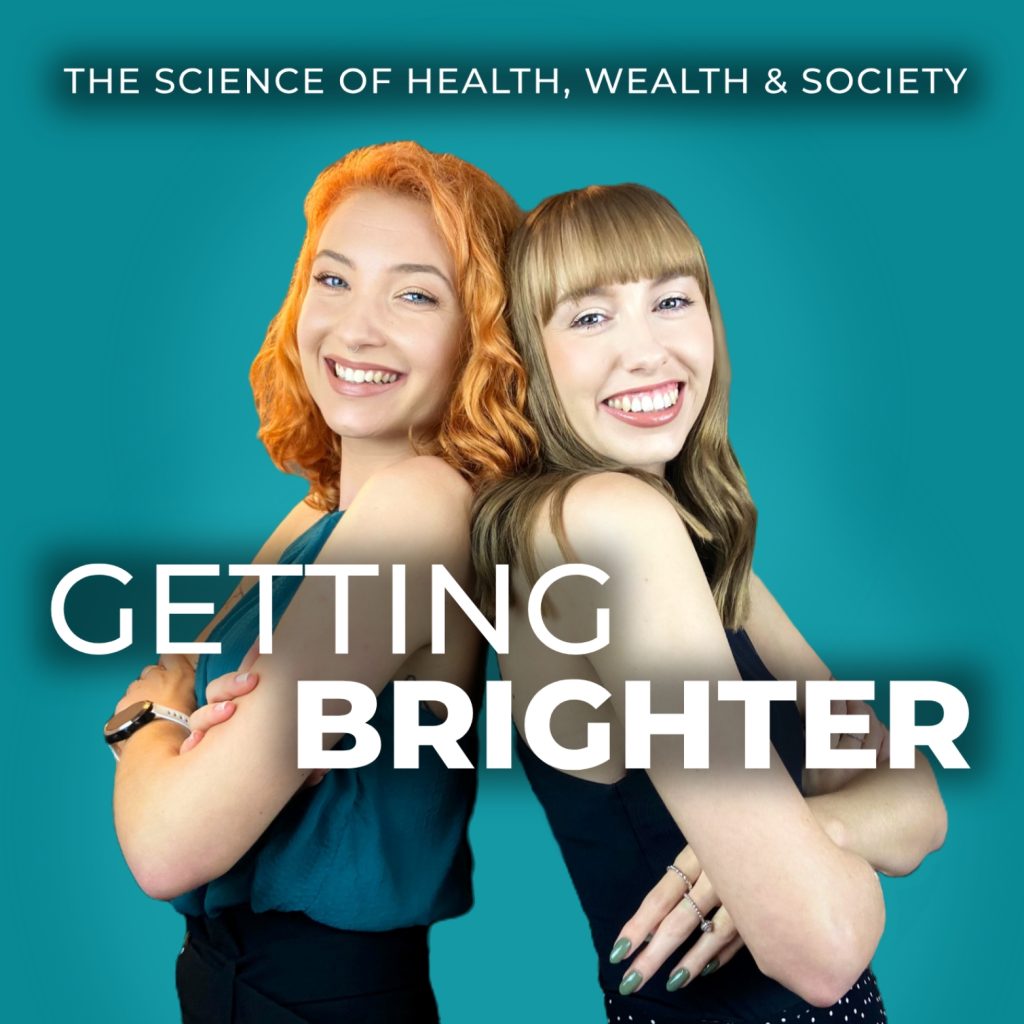
Getting Brighter is a science communication podcast where we draw on psychological science, but also science from medicine and other related disciplines to give people advice and actionable insights into what we can all do better based on the science that we have. Part of the reason we thought we might be well placed to do this is because we’re both psychologists, and we have access through our institutions to a lot of research, and academic literature, which otherwise is unfortunately, often hidden behind paywalls or is massively complicated, and uses scientific terms and lingo which is simply inaccessible to an everyday person.
Click here to listen to the podcast.

In late 2020, Nina, an SWDTP student, applied for impact funding to produce ‘Black Future Dr’. This was created as Nina noticed a significant divide in the ratio of minority to non-minority students. At the time there was a 22.60% difference in black African-Caribbean students and white students receiving a grade of 2:1 or higher. Even at a PGR level, only 18.1% of students identified as black or minority ethnic.
Black Future Dr was created on a whim during the first year of my PhD, and was one of the main highlights of my experience as a doctoral student. Early on in my PhD, I found myself stuck on the lack of diversity and caught up in the question of, why aren’t there more of us? The idea of a podcast focused on showcasing the experiences of black doctoral students in the UK and highlighting our presence randomly popped into my head, and I sent out a tweet on Twitter (now known as X) asking what people thought of the idea – and the response I received was extremely encouraging. I applied to the SWDTP’s Impact Fund almost immediately and set about finding my speakers and the topics we would cover. As I decided to do everything myself – including editing the episodes, which I had no experience of doing! – it was a very intense and time-demanding experience, so I would always recommend having a team behind a podcast, and not just one person. That said, I’m really glad that I decided to undertake this in the first year of my PhD, as I’m not sure that I would have had the time to do it later on. It also taught me a range of transferrable skills that I am still using to this day, as well as increasing my confidence in being able to undertake and excel at new challenges.
Since the Industrial Revolution, the concentration of wealth held by a minority of agents that benefitted from intergenerational wealth and education was redistributed. Workers became more productive, and economies began accumulating capital. As households became wealthier, economic inequalities narrowed, yet heterogeneity remained – not all were equal in labour market skills nor had equal access to financial markets.
It seems clear that if heterogeneities are ubiquitous in economies, serious dynamic models should account for these.
This event was partly funded through the SWDTP‘s academic-led collaboration fund. Click here to learn about funding opportunities for colleagues at our partner institutions.

The inaugural 4M conference took place on the 20th and 21st of June 2024 at the University of Exeter. The conference aimed to provide a platform for researchers and non-researchers to share their work relevant to the 4Ms, and provided an opportunity to form and build connections that will help ensure research on the 4Ms is innovative, high quality, aligned with needs and priorities, and impactful.
There were 150 attendees, from 13 countries and five continents. Academic attendees represented 37 universities, and 28 non-academic organisations were also represented. Over one third of attendees were students.
Activities included: three keynote talks from leaders in menstrual health (Prof Hilary Critchley, University of Edinburgh; Dr Mandi Tembo, LSHTM; Prof Martha Hickey, University of Melbourne); 27 short talks from abstracts; themed panel discussions with academics and non-academic organisations; 30+ posters; stalls; a zine to incorporate the participant/public voice into the conference in a creative way; glossary of terms to aid interdisciplinary understanding; a small art exhibition; an evening event with comedy; prizes for the best poster and oral presentation by an ECR.
All sessions were live scribed by an illustrator and the visual summaries are available on our website, along with the conference book, which contains all oral and poster abstracts, and the zine. We also commissioned a short conference film, which is currently still in production and will be uploaded to our website when ready.

We had some press coverage of the conference, including an interview on BBC Radio Devon’s Breakfast Show on the 20/6 and a live interview on BBC Radio 4’s Woman’s Hour on 21/6. It was also covered on BBC online. On LinkedIn and X, several attendees posted from the conference and/or wrote excellent reviews. Some attendees also wrote reviews in blogs on their websites: South West International Development Network; Poppy Taylor (PhD student); Charlotte (MSc student – not yet online). Some of us (academics and GPs) were also invited to write an editorial for the British Journal of General Practice, which will be published as part of a special issue on women’s health in September 2024.
Fifty-seven attendees responded to a feedback survey, with 100% rating their enjoyment of the conference as either 4 or 5 out of 5 (average rating 4.8; 82% 5/5 rating). According to free text responses, attendees particularly liked the diversity of the audience, in terms of sector, demographic, geography, and career stage. The conference significantly impacted attendees by deepening their understanding of complexities in menstrual health, encouraging collaboration, and inspiring new ideas in research and advocacy. Many participants left motivated to address gaps in menstrual health, particularly around education, and to include diverse voices in their work. The event helped build valuable connections and provided practical insights into better communicating and applying research in real-world contexts. Multiple attendees said that they would follow up on connections made at the conference, and that they had already discussed plans for multidisciplinary collaborations. This collective enthusiasm and commitment to advancing the field underscored the conference’s significance as a catalyst for positive change in menstrual health awareness and advocacy. The participants overwhelmingly praised the conference, expressing their gratitude and enthusiasm for the event. Many highlighted their enjoyment and the value they found in both the content and the social aspects, noting how well-organised and impactful it was. There were several requests for the conference to be held regularly, reflecting its importance to their professional and personal growth.

Publications:
(Based on MSc module assignment ‘Designing and communicating research’ (DCR))
Published in: The Linguist (summer edition), CIOL magazine.
“Is research working? Better use and understanding of translation are key to improving global research”
https://www.ciol.org.uk/sites/default/files/TheLinguistSummer24-website.pdf
Book translation:
one of a series of 4 books in English on ‘Shanghai Culture’.
Title: Shanghai Women,
Author: MA Shanglong,
Translator: Celine Garbutt.
Publisher: Shanghai University Press
ISBN 978 – 7 – 5671 – 4647 – 1

Join us and our fascinating panellists for an evening to discuss the book and its themes, including a Q & A session. The event will be held online, through Zoom. All are welcome. Sign up here!
Panelists:
About the Book
In Performing Deception, Brian Rappert reconstructs the practice of entertainment magic by analysing it through the lens of secrecy, deception and learning, as he goes about studying conjuring himself. Through this novel meditation on reasoning and skill, Rappert elevates magic from the undertaking of mere trickery to an art that offers the basis for rethinking our possibilities for acting in the modern world.
Performing Deception covers a wide range of theories in sociology, philosophy, psychology and elsewhere in order to offer a striking assessment of the way secrecy and deception are woven into social interactions, as well as the illusionary and paradoxical status of expertise.
About the Author
Brian Rappert is a Professor of Science, Technology and Public Affairs at the University of Exeter. His long-term interest has been the examination of the strategic management of information, particularly in relation to armed conflict. His books include Controlling the Weapons of War: Politics, Persuasion, and the Prohibition of Inhumanity; Biotechnology, Security and the Search for Limits; and Education and Ethics in the Life Science. More recently he has been interested in the social, ethical, and political issues associated with researching and writing about secrets, as in his books Experimental Secrets, How to Look Good in a War and Dis-eases of Secrecy.