Category: Funding

  • Stirring up new ideas: Harriet Hand’s RTSG Project

    By using her Research Training Support Grant, Harriet Hand, an SWDTP student, organised and facilitated a workshop to bring her research to life.


    The project’s aim

    Harriet’s research project aims to further our understanding of how creative thinking can be nurtured in the classroom. Over six weeks in March and April 2022, she held a series of workshops as a research event with a group of post-16 learners in Bristol.

    The aim was to experiment with mapping as a method of making space for, and activating, creative thinking. Engaging with Deleuze and Guattari’s philosophy and the concept of the rhizome, the group explored how mapping techniques mobilised properties such as connectivity, multiplicity, open-endedness and disruption as a way of making sense of ourselves in relation to the world around us.


    Paper marbling

    To mark the end of the event, the Suminagashi artist Sarah Amatt ran a workshop in Japanese paper marbling. Suminagashi means ink (sumi) floating (nagashi) on water and is a paper marbling practice that can be traced back to the 800s. The workshop became a way of intensifying the some of the feelings of movement, chance and open-endedness that had been experienced over the course of the research event.

    As the swirling inky papers were gathered at the end of the workshop, students shared what they thought of as the ‘rules’ of Suminigashi: the beauty in things we thought had been ‘mistakes’, the unpredictability, the endless possibilities, of taking time, pausing, allowing the mixing of things to do its work.


    Harriet also produced a video to bring together documentation of the artist workshop with traces of her theoretical and practice-based explorations of creative thinking. Watch it below:


    This workshop was made possible by the SWDTP and RTSG funding. Bristol + Bath Creative R + D provided the workshop space in Bristol’s Watershed. The students were Aalia, Charles, Lul and Ramla from North Bristol Post-16 Centre (Cotham). Sarah Amatt’s work can be found at https://www.sarahamatt.com/

  • Tom Avery’s OIV to University of Pennsylvania, USA

    Education researcher, Tom Avery was awarded Overseas Institutional Visit funding to travel to the University of Pennsylvania (UPenn) for two weeks in March 2022.


    Purpose of the trip

    Tom’s research investigates the experiences refugees have of school in the UK. He is investigating this from a language policy perspective, exploring the presence and effects of raciolinguistic and colonial ideologies in school curricula, school policy, and teacher practice. Effectively asking how refugees navigate a school system designed for white, British speakers of English.

    The purpose of Tom’s OIV is to meet with Nelson Flores (an eminent scholar on raciolinguistics) and his PhD students at the University of Pennsylvania (UPenn) in order to develop long-term professional networks, engage in knowledge exchange, and take part in a doctoral symposium.

    In the run up to his visit, Tom was also granted a Graduate Student Award by AAAL for his upcoming presentation at the AAAL 2022 conference. The award is merit-based award that supports the attendance of outstanding AAAL graduate student members at the conference.

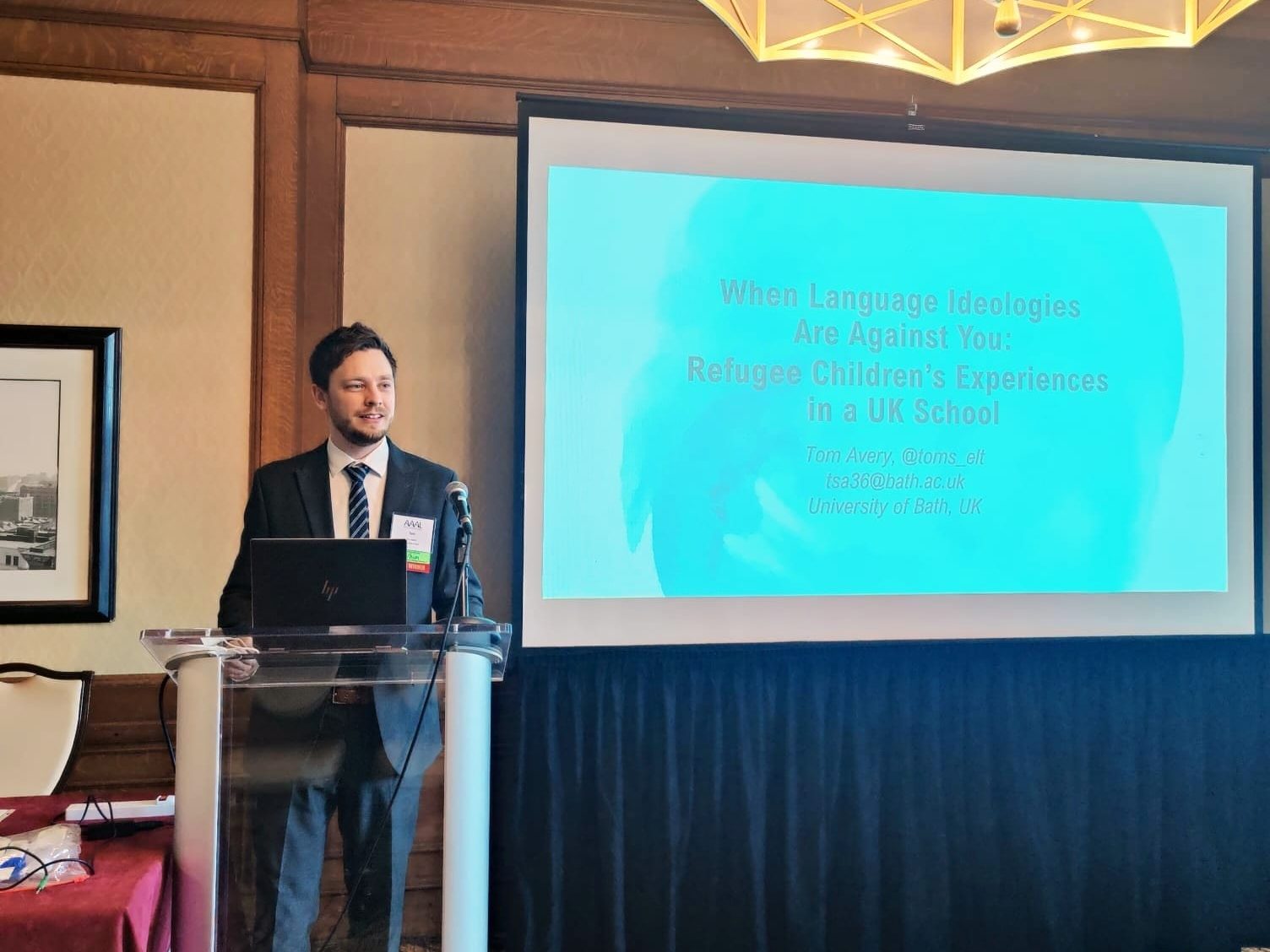
    Tom presenting at the AAAL conference

    Do you think your visit made an impact to your PhD research?

    “This trip was an excellent chance to meet and talk with some of the major voices in my field, which I would not have had a chance to do otherwise. I was able to participate in seven lectures at an Ivy League school (UPenn) and listen to over 40 speakers during the two conferences I attended.

    I was also able to get some of their feedback on my work and present my work to groups of scholars who are working on the cutting edge of the field. Being in the USA in person also gave me a chance to engage in and grapple with current debates and controversies in my field, some of which will form a key part of my doctoral writing (e.g. is Academic English a tool of colonial domination or a requirement for emancipation).”


    Would you recommend the OIV Scheme to other students?

    Absolutely – and for all the reasons above! The process was quite simple and the SWDTP team were very helpful.

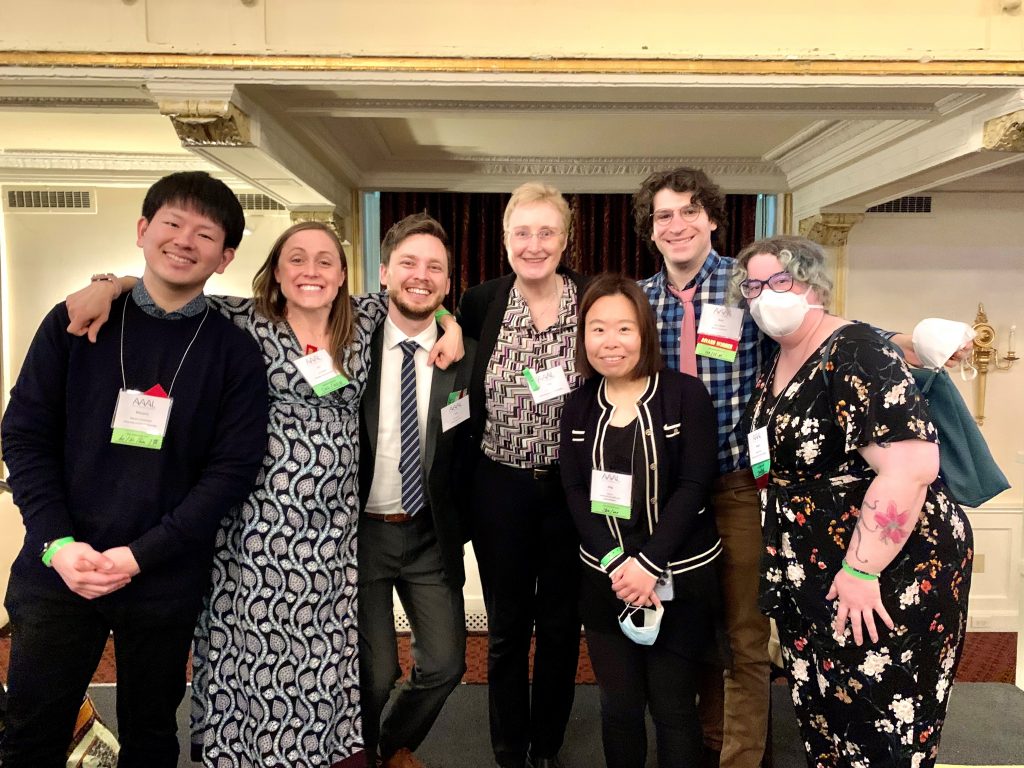
    Photo of Tom Avery with the other GSA awardees and Patsy Duff, the AAAL president

    About the OIV funding

    The Overseas Institutional Visit (OIV) scheme is a funding opportunity available to ESRC funded students (more information on the scheme can be found here). The scheme aims to provide the opportunity for postgraduate researchers to study at an overseas research institution for up to 13 weeks, in order to network with academics and researchers by participating in departmental seminars, events, and training activities.

  • Black Future Dr: A Podcast Increasing the Visibility of the Black Doctoral Experience

    Black Future Dr: A Podcast Increasing the Visibility of the Black Doctoral Experience

    Racial inequality is a prominent issue in the UK, and this extends into education.

    Black future dr featured image. Image Description: A Black student sitting outside on campus

    We can see this gap at an undergraduate level, with a 22.6% difference between white and black African-Caribbean students receiving a 2:1 degree or above.

    We also see this gap at postgraduate level, with black and minority ethnic students being far less likely to go on to higher research degrees, such as PhDs and professional doctorates, than white students. In fact, in 2020, only 18.1% of research postgraduate students identified as black or minority ethnic.

    Despite these statistics, there is a growing community of black students pursuing doctorates in the UK. To increase our visibility and celebrate our achievements, Black Future Dr has been developed.

    Black Future Dr is an upcoming podcast, funded by the SWDTP’s Impact Fund and dedicated to showcasing the experiences of black doctoral students in the UK. This includes PhD students, as well as students doing professional and medical doctorates. There will be 12 episodes in total, with each focusing on a different student studying a different subject at a different institution. Each episode will be 20 minutes long and will be hosted by Nina Higson-Sweeney (@n_higsonsweeney), a SWDTP-funded PhD student at the University of Bath. We will be discussing a variety of topics, including supervision, motivation, mentorship and non-traditional pathways.

    Episodes will be released weekly starting from Monday 3rd May 2021 and can be listened to via Acast as well as on Spotify, Apple Podcasts, Google Podcasts, and Deezer.

    Current guest speakers for the podcast include:

    • Lateesha Osbourne, a final-year PhD student in Psychology at the University of Bath
    • Rees Johnson, a third-year PhD student in Law at the University of Manchester
    • Adewale Kukoyi, a second-year student studying for a professional doctorate in medicine at the University of Bristol
    • Alanah Mortlock, a second-year PhD student in Gender Studies at the London School of Economics
    • Emmanuel Johnson, a third-year PhD student in Education at Coventry University
    • Louisa Brotherson, a third-year PhD student in Earth Sciences at the University of Liverpool
    • Dave Mankhokwe Namusanya, a second-year PhD student in Sociology at Abertay University

    With 5 more guests to be announced!

    To keep up to date with the podcast, follow @BlackFutureDr on Twitter or subscribe to the podcast on your chosen platform.

  • ‘Decolonization is not a metaphor’

    ‘Decolonization is not a metaphor’

    Suzanne van Even and Zibah A. Nwako

    Suzanne van Even and Zibah A. Nwako discuss the first session in our Decolonising Social Research Series: Decolonising Theory.

    On Thursday 19 November 2020, the SWDTP’s ‘Decolonising Social Research’ series launched with a provocative seminar on Decolonising Theory with speakers Foluke Adebisi (Senior Lecturer in Law, University of Bristol), Mark Jackson (Senior Lecturer in Postcolonial Geographies, University of Bristol) and Arathi Sriprakash (Professor of Education, University of Bristol).

    This seminar series came at an opportune time. As doctoral researchers in the Social Sciences ourselves, we find it very important to engage with decolonial critiques and the decolonisation literature more generally. It is of particular importance in the context of co-creation of knowledge whereby social researchers, like us, work closely with participants, community stakeholders and policymakers. For us both, our research seeks change and impact – not just to engage in knowledge translation, but also with the aim of emancipating and empowering knowledge producers and knowledge receivers, respectively.

    Foluke’s presentation, Rhodes Must Fall, or Rhodes Must Read More Fanon? (title inspired by a tweet by @fanoniscanon), considered what we mean when we talk about decolonising theory. Are we trying to unsettle the concepts that are the foundational presumptions of our discipline(s) or are we leaving those as they are? Do we add in other concepts which will never reach the eminence of the foundational concepts that we hold dear?

    Foluke reflected on how diversifying literature relates to decolonial thought. She argued that there is a difference between including ‘diverse literatures’ (in our research) and decolonial thought. She posited that a major distinction between decolonial thought and diversity is that the latter makes no distinction between epistemic and embodied difference.

    Using a table as a metaphor (the table representing colonised space), Foluke briefly discussed the four main schools of decolonial thought:

    1. Settler states (Americas, Australasia, South Africa) – part of the table does not belong to you, can you give it back to us?
    2. Post-colonial states (Africa and Asia) – well, that’s a nice table, can we join you there?
    3. Latin American critical school (Latin America and Caribbean) – is that really a table? What is it meant for? Should we destroy it and think of a table in a different way?
    4. Colonising states – this category of thought is often not mentioned, because some argue that you cannot decolonise empire (Tundama, 2016).

    Finally, Foluke questioned what decolonial research can possibly do? Referring to Escobar (2018), hooks (1991), and Mignolo (2016), she contemplated whether decolonising theory can be liberatory.

    Mark’s presentation on Decolonizing Theory: Perspectives from Geographies focused on how to reverse the centre-periphery relationship. He questioned whether the vocabularies, categories of thought, and concepts employed by normative social science are suitable and effective means for making sense in, or of, non-Western worlds?

    Although 80% of the world is located outside of Europe, European thought (processes) define our view of the world. Yet, non-Western worlds do not use European concepts such as ‘gender’ and colonised notions of ‘nations’. Mark suggested that decolonial critique attempts to unsettle this – by turning Eurocentric assumptions and concepts on their heads.

    As researchers, we take people’s lived experiences and transpose them through pre-conceived categories, thereby assimilating them into terms that can then be put to work. We argue that as a result of this, knowledge is formed. Mark postulated that this process of identification, extraction, re-purposing and circulation is a form of commodification.

    Mark posited further that there are four main implications for decolonising theory:

    1. Need to enable theorising from the outside.
    2. Give up on the idea of a universal standard and instead embrace ‘pluriversality’ of epistemologies and ontologies (Escobar, 2018).
    3. Regard the decolonial as an option (Mignolo, 2011; Murrey, 2019; Nigam, 2020). It is not a particularly privileged mode of deriving theory but provides a range of possible strategies (Nigam, 2020) that might allow for a necessary preliminary step to reconstitution.
    4. Theorising well is fundamentally about fostering caring. In order to know, you need to care (Dalmiya, 2016).

    In her presentation titled Decolonising Theory: The erasures of racism in education and international development, Arathi asserted that we need to ask questions of the theories that we use.  Moreover, she warned us against superficially adopting the term ‘decolonisation’ as it has become a bit of a buzz word. The aim of decolonisation is to unsettle power relations, in real and material ways. Decolonisation should bring about the repatriation of indigenous land and life; it is not a metaphor for other things that we want to do to improve our societies (Tuck and Yang, 2012). Using decolonisation as a metaphor, keeps colonial structures in place.

    Arathi argued that it is important to decolonise theory because it doesn’t just operate at an abstract level. Instead, theory emerges from lived experiences that shape how we act and intervene in the world in profound and concrete ways. Theories of development, and specifically theories of modernisation, have worked to divide the world into categories such as ‘developed’, ‘developing’, ‘traditional’ and ‘modern’. This entrenches the idea that people and places need to ‘catch up’, as if they were developmentally backwards. This type of theorising that persists today is based on a deficit model, positioning the problem of poverty with racialised and colonised people and their practices. In doing so, it secures primarily European and Anglo-American epistemologies, industries and interventions as valid and good, forming the material effects of epistemic injustice. In education, this colonial way of thinking makes educational inequality irrelevant whilst it is, in fact, profoundly relevant for understanding educational injustices (e.g. Mills, 2007, ‘epistemologies of white ignorance’).

    Arathi ended her presentation with a reading of Abhay Xaxa’s (2011) powerful poem “I am not your data”, reflecting Tuhawai Smith’s (2012) words that “’research’ is probably one of the dirtiest words in the indigenous world’s vocabulary” (pp. 1).

    The presentations resulted in thought-provoking discussions, indicating from this first seminar that there are still a lot of questions to be answered. For example, can we decolonise theory without de-colonising theory? Foluke posited that even after years of decolonising theory – colonial theory is still dominant. When we think about neo-liberal constructions, we are more likely to find validation for decolonising theory than using theory that decolonises. The danger is that we take the path of least resistance. So, it is always important to point out that this is not the destination, this is not where we are headed. Even if we are trying to be more inclusive in our decolonising of theory, we are not just doing that because it is a good thing to do. We are doing it because it brings about a new world. And as social researchers, this is the change and the impact that we seek to achieve through decolonising theory!

    The audio-visual recording of the Decolonising Theory session can be watched here: https://t.co/RDVWf7thyT

    Suzanne van Even is a PhD student at UWE in Bristol. Her research explores how people of African Caribbean and African ancestry cope with mood disorders associated with having an autoimmune rheumatic disease. Suzanne originally trained as a solicitor in the Netherlands before working as a fundraiser for arts charities in both the Netherlands and the UK. She is now retraining as a psychologist. Suzanne’s research interests include the mental health and wellbeing of African and African Caribbean men and women, community-based research and creative research methods. Twitter: @SvanEven77 

    Zibah A. Nwako completed her PhD at the School of Education, University of Bristol. Her thesis is titled ‘In Our Own Voices: A Critical Participatory Study of the Wellbeing of Female Undergraduate Students in Nigeria’ and she researched this topic using a postcolonial feminist lens. Zibah is a speaker, trainer and consultant on women’s personal development and gender justice. Her research interests include the personal welfare and wellbeing of girls in Africa, non-formal education and informal learning, qualitative research methodologies and creative methods. Visit her website and blog here: www.zibahnwako.com

    For more information about the SWDTP’s ongoing ‘Decolonising Social Research Series: Click here.


    References

    Dalmiya, V. (2016). Caring to Know, Comparative Care Ethics, Feminist Epistemology, and the Mahãbhãrata. Oxford University Press.

    Escobar, A. (2018). Designs for the Pluriverse, Radical Interdependence, Autonomy and the Making of Worlds. Duke University Press.

    Escobar, A. (2018). ‘Farewell to Development’. Available from https://greattransition.org/publication/farewell-to-development

    hooks, b. (1991). Theory as liberatory practice. Yale JL & Feminism, 4, pp. 1.

    Mignolo, W. (2011). Epistemic Disobedience and the Decolonial Option: A Manifesto. Transmodernity, 1 (2), pp. 3-23.

    Mignolo, W.  (2016). The communal and the decolonial. Available from http://www.turbulence.org.uk/index.html@p=391.html

    Mills, C. (2007). White ignorance. Race and epistemologies of ignorance, 247, (Sullivan, S. & Tuana, N., Eds) pp. 26-31. State University of New York Press.

    Murrey, A. (2019). ‘When spider webs unit they can tie up a lion’. Anti-racism, decolonial options and theories from the South. In: Routledge Handbook of South-South Relations (Fiddian-Qasmiyeh, E. & Daley, P., Eds).

    Nigam, A. (2020). Decolonizing Theory, Thinking Across Traditions. Bloomsbury Publishing.

    Smith, L. T. (2012). Decolonizing methodologies: Research and indigenous peoples. Zed Books Ltd.

    Tuck, E. and Yang, K. W. (2012). Decolonization is not a metaphor. Decolonization: Indigeneity, Education & Society, 1 (1), pp. 1-40.

    Tundama, N. (2016). You cannot decolonise colonialism. Available from https://www.youtube.com/watch?v=hXJS8d2T1IE  

    Xaxa, A. F. (2016). I am not your data. Available from http://adivasiresurgence.com/2016/01/13/i-am-not-your-data/

  • SWDTP Funded Research Ethics Conference Update

    I would like to take the opportunity to welcome you to the Research Ethics Conference (REC) blog.

    As the Chair of the REC I thought I would take the opportunity of writing a blog to keep you all updated on the progress of REC2021.

    First of, I would like to extend my thanks to the SWDTP team, especially the Collaboration Facilitator for helping me with my application for £5000 to put this conference together and also Sonja, Richard, Joanna and Helen for approving this and/or supporting me. If anyone has any collaborative funding ideas, I highly recommend speaking to the Collaboration Facilitator who will guide you through the process. More information about Student-Led Collaborative Funding can be found here.

    Before I update you I would like to share with you the following key dates (Please check www.researchethicsconference.co.uk for submission and registration details and links):

    • Conference date – Friday 26th March 2021
    • Conference back-up date – Friday 25th June 2021
    • Call for papers opens 24th August 2020 
    • Call for papers closes 1st December 2020
    • Delegate Registration opens 7th January 2021

    Ethics has never been as important as it is now. The world we live in is changing at a dramatic pace and we must maintain rigorous and critical ethical practices of the research journey, across all disciplines throughout STEM and HASS. But what exactly is ethics and what does it mean to conduct ethical research? 

    While academic and other organisations have ethics committees and processes in place, there is often little space or time in institutions to discuss what ethics means in practice, how our understanding of ethics varies across disciplines, and how practices change and develop over time.  Research ethics can sometimes run the danger of being misinterpreted, underplayed or merely viewed as a ‘tick box’ exercise.  Academics can  also find themselves ‘playing catch-up’ due to the rapid progress of research and new methodologies and discoveries that we have to regulate for the first time.

    We invite academics as well as local stakeholders who have an interest in research ethics to share knowledge and best practice to help raise understanding of the importance of research and practical ethics. This conference will provide an opportunity for presenters from across all disciplines to share their findings collected through ethical practices, as well as any ethical dilemmas that arise from conducting primary data collection or the interpretation of statistics and other secondary data‘ (Research Ethics Conference, 2020).

    The conference committee currently consists 23 committee members, made up of academic and professional staff, doctoral students, external organisational partners and a variety of members from universities within within the South West of England and Cardiff University. I am very grateful to be working with such a large committee, who all have an interest in research ethics. You can see who is member of the conference committee by clicking here. If you would like to join the committee you are most welcome. Please email REC2021@exeter.ac.uk to find out more.

    Over the last 5 weeks we have held 2 committee meetings to discuss our plans for REC2021 and have made extraordinary progress. The committee has so far discussed:

    • Call for papers – Call will be released on 24th August 2020, closes on 1st December 2020.
    • Delegate registration – Delegate registration opens 7th January 2021 via Eventbrite.
    • Keynote speakers – The committee has put forward suggestions of potential keynote speakers. We aim to have two keynote speakers from contrasting disciplines.
    • Workshops – The committee has shared workshop ideas for workshops before, during and after the conference, including workshops aimed at external organisations.
    • Cross-discipline Inclusivity – Ways to make sure the conference is accessible across all disciplines.
    • External organisations – Ways to make sure the conference is accessible to external organisations for presentations and as a delegate.
    • Presenter support and preparation – The ways that we as a conference team can support paper and posters presenters, from writing a abstract to presenting.
    • Research Posters – Relaxing poster specifications to allow innovation, for example the use of QR codes, videos, sound 3D posters etc.
    • Social Media and REC Website – making sure we have an online presence and accessible, readily available information.
    • Covid-19 – Conversations around Covid-19 restrictions using the guidance from the University of Exeter and UK Gov.

    Our call for papers team (Rebekah, Elis, Alice, Ginny, Fida and Lois) which is lead by Maria have already nearly completed the abstracts submission information ready for our 1st call for papers to be open on the 24th August 2020 (closes 1st December 2020). The CFP team have worked exceptionally hard to make sure the conference is accessible across all disinclines and external ogranaisations. To contribute towards accessibility and inclusivity across all disciplines, the conference committee decided not to have a theme and to keep the conference as open as possible. We hope that this will help contribute towards opening up cross-discipline conversations.

    The conference team is also working towards creating and organising workshops. If you have any suggestions or know anyone that would be interested in hosting a workshop, please email REC2021@exeter.ac.uk addressed to Tracey.

    As a conference team we are carefully monitoring government and university advice on Covid-19 restrictions. We will be keeping up-to-date on these restrictions and we will posting updates as and when we get them.

    I will aim to update this blog after every committee meeting to give you all an update of how things are getting on.

    Best Wishes

    Warren

    Research Ethics Conference 2021 Key Dates

    • Conference date – Friday 26th March 2021
    • Conference back-up date – Friday 25th June 2021
    • Call for papers opens 24th August 2020
    • Call for papers closes 1st December 2020
    • Delegate Registration opens 7th January 2021
  • Standing Seminar in Critical Theory Series 2020

    PLEASE NOTE:

    With a heavy heart we had to postpone three events due to COVID-19:

    (1) Two workshops: (un)Doing Research: Feminist Decolonial Provocations, with Dr Rosalba Icaza (The Hague) and The Arcane of Reproduction Then & Now, with Leopoldina Fortunati (Italy). More details: SSCT website).

    (2) the first SSCT Symposium on climate change and critical theory. We will resume our activities as soon as we can. Reading groups will resume next academic year too
     
    Please keep in touch. If you wish to be added to the SSCT Mailing list, please let us know
     
    Contact: A.C.Dinerstein@bath.ac.uk
    Convenor SSCT
    https://www.bath.ac.uk/projects/standing-seminar-of-critical-theory/


    Dr Ana Dinerstein, critical theorist, political sociologist and scholar activist, has used the SWDTP’s Pathway Led Collaboration Funding to set up several events in her Standing Seminar in Critical Theory Series. This follows from her incredibly successful events that she ran in 2019.

    The Standing Seminar in Critical Theory (SSCT) aims to build a permanent, transdisciplinary and inter-institutional space for critical thought across the South West Doctoral Training Partnership institutions.

    [photo description] People sitting in a seminar room, listening.

    The initiative seeks to unite critical theorists within and across the South West Doctoral Training Partnership (SWDTP) institutions, and in dialogue with external partners and organisations. Critical theory, for us, is not simply a set of ideas that can be applied to understand reality. Rather, it is an active, iterative cycle of action and reflection that, embedded in social practices, seeks and enacts social transformation by offering a critique of society.

    The SSCT is intended as a transdisciplinary space where students and academic colleagues across the SWDTP can meet to discuss the critical theories and radical epistemologies stemmed from the Frankfurt School and the Marxist tradition, Feminist, and post/de/colonial studies, lies at the intersection of these students’ and academics’ respective subfields and research objects.  

    SSCT has 3 Events coming up:


    The Arcane of Reproduction Then & Now, with Leopoldina Fortunati

    Fri, 6 March 2020, 18:00 – 20:00

    Priory Road Complex, 12 Priory Road, Bristol, BS8 1TU.

    Main speaker: Leopoldina Fortunati (University of Udine)

    Discussant: Katie Cruz (University of Bristol)


    What is reproductive labour and why is it important? We will discuss it with Leopoldina Fortunati, one of the founders of social reproduction theory. Fortunati began her activism in the context of workers’ struggles in the 1960s and 1970s in Italy and was a key member of the feminist movement for Wages for Housework (https://www.viewpointmag.com/2013/09/15/learning-to-struggle-my-story-between-workerism-and-feminism/). She then became the author of the classic book “The Arcane of Reproduction: Housework, Prostitution, Labor and Capital” (1981), and – with Silvia Federici – of “Il Grande Calibano: Storia del corpo sociale ribelle nella prima fase del capitale” (1984).

    Katie Cruz is a senior lecturer at the University of Bristol. Her research focuses on Marxist feminist theory and the legal regulation of sex work (http://www.bristol.ac.uk/law/people/katie-a-cruz/index.html).

    Click Here to Register for this Event


    (un)Doing Research: Feminist Decolonial Provocations with Dr. Rosalba Icaza

    Fri, 5 June 2020, 12:30 – 16:00 

    Ensemble Room, The Edge, The University of Bath, Bath, BA2 7AY

    [photo description] woman presenting to a seminar group

    What would it mean to acknowledge the extraction, expropriation, and erasures that sustain our present possibilities for critical thinking within academia? Is it possible to respond to the possibility of an ethical life that is not structurally implicated with the suffering and the consumption of life of earth and others?

    In this workshop, we will explore the conditions for the possibility that emerged for (un)learning when feminists and non-feminist academic-activist Women of Color committed to epistemic justice collectively dealt with two intertwined challenges: the violence of critical thinking and the violence of re-presentation.

    Defying dominant frameworks of political intelligibility centred on the authoritative “I”, we are speaking as yosotridades (weus) and through this we are pluralizing the places from where we are thinking with/from. Our point of departure is the (im)possibility of speaking if we haven’t heard first.

    The workshop has been organised by the Standing Seminar in Critical Theory and the research cluster Decolonising Knowledge & Practice (DECkno), convened by ACD and LE, Department of Social and Policy Sceiences, University of Bath.

    Event Convener: Callum Cockbill

    Contact: cc758@bath.ac.uk

    Lunch will be served in the Ensemble Room between 12:30 and 13:30. The workshop will commence at 13:30 until 16:00.

    Click here to Register for this Event


    REFORMULATING THE ENVIRONMENTAL CRISIS. Critical Theory Symposium

    Time to face the storm?Reformulating the environmental crisis with critical social sciences

    One-Day Symposium

    Standing Seminar in Critical Theory

    funded by the South West Doctoral Training Partnership

    15th of June – The Edge – University of Bath Campus

    Standing Seminar in Critical Theory Photo: 4 Presenters sat in a line listening to a fifth presenter present to a lecture theatre

    We are facing a storm. We, humans, are at the centre of a hurricane. A severe crisis of the reproduction of life in all its forms is unfolding. We hear it in the media, at school and university, at work and in the streets. Not a single day goes by without our social media newsfeed, the radio, the television or our neighbours reminding us of the environmental crisis. A sense of urgency and a discourse of fear have penetrated our daily life. New social movements have emerged to make us aware of the irreversibility of the problem at hand.

    To what extent can our knowledge and critical thinking explain this multifarious reality? Has the environmental crisis highlighted important limits in our imagination as critical theorists? More fundamentally, has the crisis questioned the contemporary relevance of critical social sciences, let alone critical theory, to the point that all we have is ‘science’ as an explanatory framework for crisis?

    There is a risk that the complex world crisis is understood only as ‘environmental’, with implication of producing a limited analysis and proposing limited solutions. By isolating the environmental crisis from the institutions, politics, social practices, social relations, economic system, epistemological approaches, we are failing to understand the intricacy of the process that brought us to this point of self-destruction in human history.

    This first SSCT Symposium is an invitation to interrogate and critique the present formulation and reality of ‘environmental’ crisis to propose alternative ideas, views and paradigms that contest the capitalist, colonial and patriarchal order that produces and reproduces the crisis. While scientists are demonstrating how the environmental crisis is precipitating the end, it is up to us, critical social scientists to move beyond our own limitations, beyond the confines of disciplinary insularity towards a collective discussion about what kind of political, social, cultural and economic relations are contributing to the crisis and explore unseen possibilities.

    CALL FOR PAPERS

    CALL FOR PAPERS will be out mid-February on the SWDTP and the SSCT websites.

    In anticipation of the CFP, we welcome contributions from all disciplinary backgrounds and critical theory perspectives on the following potential themes:

    1. Critical theory today: Anarchism, feminism, Marxism, decoloniality.
    2. The crisis of social reproduction and the commodification of life itself.
    3. The political economy of Ecocide and new forms of accumulation of capital.
    4. Racialised and gendered violence.
    5. Eurocentrism, Epistemicide and epistemological diversity.
    6. Social (rural, urban, indigenous, environmental) movements and the crisis.
    7. Where is utopia in all this?
    8. Surveillance capitalism and the crisis of democracy in the digital era.
    9. Technology, trans-humanism.
    10. Post work, post capitalism.
    11. Other?

    Papers from PGRs and early-career academics will be prioritised.

    CONTACT: Ana.C.Dinerstein@bath.ac.uk

    REGISTRATION

    • ABSTRACT SUBMISSION REGISTRATION. If you are planning on submitting an abstract for a presentation at the symposium, please select the “abstract submission ticket”. Abstract submissions OPEN 17.02.2020 and CLOSE 01.04.2020.
    • GENERAL TICKET REGISTRATION. For both SWDTP and non-SWDTP students who wish to attend the symposium but not submit an abstract, select “general admission ticket”, available from 13.02.2020.

    PLEASE NOTE – if you register for the symposium with the intention of submitting an abstract you are ALREADY registered to attend the event. You will not need to register again at any later stage.

    For all registrations please indicate your dietary preferences and home institution. If you require any special assistance, please do let us know and we will make sure this is provided for you.

    Click Here to Register to Attend this Event


    We look forward to seeing you at one of these events soon!

  • Chloe Asker: My OIV to McMaster University, Canada

    Chloe Asker: My OIV to McMaster University, Canada

    University Hall: McMaster University

    From September to December 2019 I went on an Overseas Institutional Visit (OIV) to McMaster University in Canada. During my time at McMaster I was hosted by Professor Gavin Andrews, an academic based in the faculty of Health, Aging & Society. His work ranges from gerontology, to complementary and alternative medicine (CAM), to theoretical work in health geography.

    The University is based in the city of Hamilton, a post-industrial steel city in the Greater Toronto Area (GTA) on the shore of Lake Ontario that lies in the traditional territories of the Mississauga and Haudenosaunee nations. Over the 12 weeks I developed a real fondness for Hamilton (or HamOnt, or the Hammer). It has a vibrant arts, film and creative community and houses a number of independent cafes and restaurants; and as a consequence, it sometimes referred to as the Brooklyn of Canada.

    Also, due to the city’s architectural mix and low permit costs, the film and television industry uses the area as filming locations. Shows such as HBO’s ‘The Handmaid’s Tale’ and Netflix’s ‘Umbrella Academy’ have been filmed in the city.

    OIV scheme

    The Overseas Institutional Visit (OIV) scheme is a funding opportunity available to ESRC funded students (more information on the scheme can be found here). The scheme aims to provide the opportunity for postgraduate researchers to study at an overseas research institution for up to 13 weeks, in order to network with academics and researchers by participating in departmental seminars, events, and training activities.

    Chloe Asker at Niagara Falls

    I was inspired to apply for the scheme back in my first year of study. I was introduced to the funding at the SWDTP’s induction, and then again when I spoke to a second year PhD researcher who was about to spend 13 weeks at a university in New York. Subsequently, I hastily wrote the trip into my ongoing research plan for the PhD upgrade review process, whilst searching for an academic I could work with overseas.

    I felt that the opportunity to meet and work with academics and graduate students from an overseas university would be highly beneficial to my development as a researcher (which it certainly was!). Moreover, the prospect of working with Gavin was exciting – I had read and used his research since my undergraduate course, and felt that being supervised by him would provide new and different lines of thought and ways of doing in health geography. I also hoped the trip would give me some time to reflect on my research post-fieldwork – as a much needed opportunity to think, network, write, and read in a new and exciting research environment.

    Planning the visit

    Organising the trip required planning and communication with multiple people and institutions. Early on I contacted Gavin to ensure he was available during my planned visit time, and I also spoke to my supervisors to make sure they were aware of my intentions. Communicating early was important as the application processes requires that your supervisor and host each write a supporting statement. Also, bear in mind the length of the application process itself, which at the SWDTP takes up to a month.

    Once I had received confirmation of the funding, I liaised with administrators at McMaster about my status and registration as visiting student, and the fees I required to pay for this (and to note that the OIV fund does not fund your institutional cost, although this is normally a nominal amount, it’s worth trying to get this waived).

    One thing that I found particularly challenging was finding suitable accommodation for my length of stay. Student sub-lets for the dates I required did not seem to exist, and was naive to the process of renting in Canada. On my application I had applied for a sufficient budget to allow me to stay in a long-term Airbnb (something I recommend doing as it gives you the flexibility that rentals may not). In the end I went with that option, and was hugely glad that I did. My Airbnb hosts (including their dog Cali) were incredible, and were local to the area meaning that they could recommend places to visit and, most importantly, cafes where I could find good coffee!

    Reflections on the scheme

    My time in Canada has been the highlight of my PhD so far. It came at an ideal time in my research trajectory. I flew out a month after I had finished my fieldwork and transcription, and the contract for my student house had ended. The timing meant that the visit gave me time to reflect on my progress and the work I had completed to date. Moreover, I felt worn down by the academic culture in the UK. The sticky sensations of anxiety and imposter syndrome were overwhelming, crippling my ability to write or talk about my research. Throwing myself in the deep-end with new challenges in a different country was both scary but also intensely energising; scrambling up my habits and mindset I had towards my research and extending my thinking whilst reading widely for the research project I did with Gavin.

    My time in Canada was hugely productive both personally: I travelled around Ontario and Quebec, visiting Niagara Falls, Toronto, and Montreal; I found a new sense of self-worth and motivation; I also met some incredible people. And academically: I planned the structure of my thesis; I drafted a thesis chapter; I researched and wrote a review paper with Gavin which was submitted to the Canadian Geographer; and I networked and chatted with graduate students and academics – creating ongoing research and social connections.

    I would encourage any SWDTP funded student who is eligible to apply to the scheme, and to get in touch with me if you want any advice or guidance on the application process and the visit itself.

    Finally, I’d like to acknowledge and thank the SWDTP for funding the overseas visit to McMaster in order to work with Gavin. As well as the faculty, administrative staff, academics, and graduate students for their hospitality, support, and kindness during her time at the University.

    To read more about Overseas Institutional Visits and how to apply: Click Here

  • Robert Mann – POST Policy Internship

    Robert Mann – POST Policy Internship

    Robert Mann recently undertook a three-month research fellowship with the Parliamentary Office of Science and Technology (POST). Here he outlines his experience and why you should consider applying too:

    I have recently completed a three-month fellowship at the Parliamentary Office of Science and Technology (POST), as part of my PhD. This opportunity was made available through the UK Research and Innovation policy internship scheme, supported by the Economic and Social Research Council.

    Robert Mann Post Fellowship Photo

    POST is Parliament’s in-house source of independent, balanced and accessible analysis of public-policy issues related to science and technology. As a bicameral office, POST works on behalf of both the House of Commons and the House of Lords. Having been founded in 1989, POST largely focuses on writing four-page briefings, known as POSTnotes. These briefings are impartial, non-partisan, and peer reviewed. During my fellowship, I was tasked with writing a POSTnote on the topic of ‘non-custodial sentences’.


    As my POSTnote is unlikely to be published soon, largely due to the General Election, I thought that I would attempt to convey three reasons why you should consider applying to undertake a fellowship at POST during your PhD:


    • You will be forced out of your comfort zone: The process of writing a POSTnote is challenging, in the best possible way. Within three-months, you are required to scope the literature; contact and arrange interviews with topic experts (including academics, third sector organisations and Government departments), condense this information into a POSTnote, before amending this work according to internal and external review comments. The difficult part of this is that your POSTnote topic does not always relate to your PhD research. Therefore, you are required to learn about a new topic and work at a pace that allows you to maintain balance and accuracy in your written work, without feeling too much like an impostor. Although this task can seem somewhat unsurmountable, it reinforces good practice for your PhD work, such as being able to manage a demanding workload and assessing the merits of research evidence. 

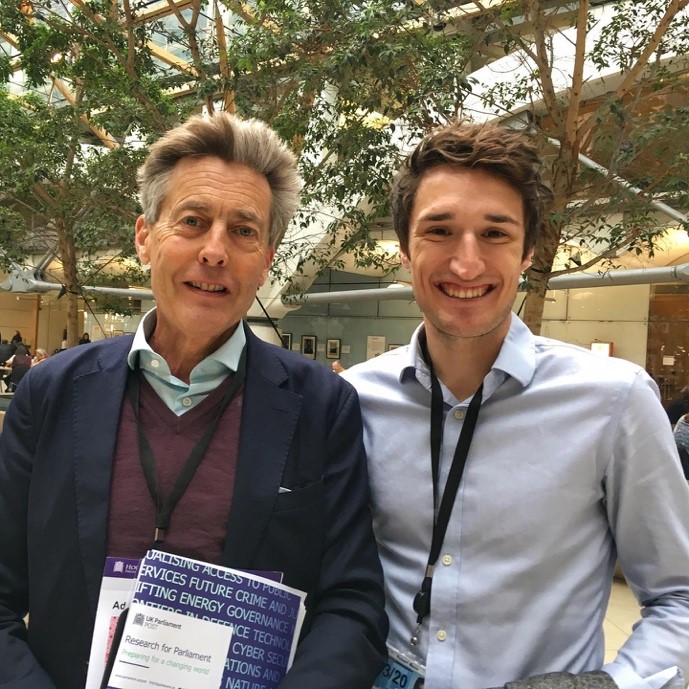
    • You get to work on behalf of Parliament: One of the more obvious reasons to apply for a Fellowship at POST is the opportunity to work on behalf of Parliament. In the first few weeks this will be represented by your unique position of being able to watch political debate, quench your thirst at one of the Palace of Westminster bars, and start playing a game of MP “I Spy”. Most POST Fellows try to arrange a meeting with their local MP during their time in Westminster too. As shown in the photo, I was able to meet Ben Bradshaw (MP for Exeter) at Portcullis House.  Alongside this access, working on behalf of Parliament comes with the responsibility of making sure that the POSTnote is fully representative of the given topic area. As the initial target audience of a POSTnote is MPs and Peers, you need to be confident that the experts that were interviewed largely support the final document and agree that it as an accurate portrayal of the topic area. Much like having to respond to reviewer comments when submitting a journal article, the POSTnote is subject to peer-review from the majority of these experts. Therefore, amending the POSTnote according to this review process is the most demanding elements of the Fellowship. Regardless, it definitely improves the final output and develops your ability to maintain an impartial writing style.     

    • Your output sits at the interface between research and policy: As a PhD student, it is typical to become academically pigeonholed. After three or four years of very specific research, you hope to come out the other side of the process with research that can be used to inform policy and develop other types of research impact. On the contrary, undertaking an internship at POST allows you to work directly at the interface between research and policy. The output of which – the POSTnote – is used to inform political debate around the topic, potentially leading to policy changes. Due to the way that topics are chosen by POST (i.e. decided by a committee that includes members of both the House of Commons and House of Lords), the work that you conduct will always be of current interest to MPs and Peers. This can either be in response to certain events, such as the recent rise in knife crime, or more of a ‘horizon scanning’ activity, such as identifying the potential challenges of an increased use of wind power in the UK. This puts you in a unique position and one that teaches you a lot about how Parliament and Government uses research to influence its policy agenda. In turn, this experience can be used to develop your own knowledge about how to best use your PhD research to inform the research-policy interface.

    I hope that these points have given some insight into my time at POST and encourage you to apply too. While my time at POST was demanding, it was also nothing but rewarding. If you are considering applying yourself, don’t hesitate to get in contact with me.   

    Robert Mann is a SWDTP Health and Wellbeing PhD candidate at the University of Exeter. You can read more about his research on our Health and Wellbeing Student Profile page.

  • Alisha Tuladhar Placement- The Innovation Beehive

    Back in the summer, Alisha Tuladhar had the opportunity to undertake a placement with The Innovation Beehive, a consultancy firm based in Cirencester. We asked Alisha a few questions about her placement and what she gained from it:

    Please give a summary of the placement and the work/activities you undertook.

    “My placement at The Innovation Beehive comprised of a range of activities. I attended various workshops, talks and presentations both internally and externally with the firms’ clients, for example: Two-days-Innovation Bootcamp Workshop at a client’s Head-Office in London, also had the opportunity to attend the Retail Week at Gloucester, attended several networking sessions in the Growth Hub and was part of the community on site.”

    Did the placement meet your original objectives and expectations? What were the tangible outputs or outcomes? Where there any unexpected outcomes or opportunities arising from the placement?

    “Yes, the placement met my original objectives and expectations. I initially had two major expectations: assisting the Consultant Head, on projects and using my research skills to help with the firms’ activities. I had expected my main job to be understanding the clients’ needs, analyse them and propose solutions that are customer-centric, technologically feasible and economically sound.

    These expectations were not only met, but in fact, surpassed. Since I was not only involved in client facing projects but also in the development of an internal training material for a large multi-national firm, it was a humbling experience for me to be working amongst an extremely knowledgeable team of consultants. This allowed me to gain an insight on how training materials were created and eventually enrolled in large MNCs.

    Moreover, again unexpectedly, I also got the opportunity to go to various events: some in London, some in Gloucester and was also invited to the Polo Club for a team outing. They were all tremendously valuable networking experiences.”

    How has the placement developed your insight into working with non-academic partners and the benefits and/or challenges of collaboration?

    “Indeed, there are a few differences whilst working with a non-academic partner. The first major difference was that the non-academic sector works in a pragmatic manner and is highly outcome-driven, rather than novelty-driven. In a PhD, we are often seeking for contribution to knowledge or are often
    truth-driven. Whereas, in a non-academic setting, it is more about outcomes and getting things done, rather than spending too much time on the foundational knowledge/ literature review.

    Second difference was the fact that there was very limited time allocated for research tasks. I think whilst doing a PhD or writing papers, the research component is lengthy and a time-consuming process, however with non-academic partners, the deadlines are stricter and tighter. There isn’t much time allocated for a deep-dive research. One needs to be extremely fast and proficient at their tasks.

    And the final difference is the number of stakeholders present.  I personally felt that whilst doing a PhD, its more about your supervisory team, which would be around 2-3, however, whilst during the placement, I was working with a larger team and had a lot of different moving parts. For example, in order to organize one event, there are clients, printing presses, designers, website, marketing communications hence it is more of a team effort with a smooth communication requirement. I personally found that in a PhD there aren’t too many stakeholders.”

    Has the experience of doing the placement made you think about the potential or the impact of your research differently? If so, how?

    “My experience at The Innovation Beehive has definitely shaped my thinking to be more wary of how my research might be applied, what value it brings to UK businesses. More specifically, I have realised that
    there is a lot of good research being done and published in Management Journals, however not many are read or known to business executives. I think the way forward needs to be more inclusive whereby the government, academia and businesses not only have access to research but also are conversing and sharing knowledge with each other. One way to ensure research impact is to publish in Open- Journals perhaps, this is something I personally will aim to do.”

    Are there opportunities for further collaboration with the organisation either for yourself, or for other students, in the future?

    “Yes, I think The Innovation Beehive team and founder, Mok, is very supportive towards students and the academic sector.
    In fact, Joe, the Innovation Director of the firm has already come to the University twice to record three academics for their Podcast. Hence, I think there is definitely more room for collaboration.”

    What advice would you give to a fellow student who is considering undertaking a placement?

    “My advice to a fellow placement student would be “listen, learn and be proactive”. I truly believe in the salience of being curious, asking the right questions, and making sure you are gaining the most of everything that your placement has to offer. Placement is a great opportunity to learn but you will only learn once you ask. So be courageous, be proactive and do your best.”

  • Alison Pearson- Cohort Building Fund

    Shut up and write sessions at St Luke’s, 2019

    As a PGR at the St Luke’s campus at the University of Exeter I had noticed that not many events and activities happen here – if you are lucky you bump into a colleague in the café or library, but it can leave you feeling a bit isolated.

    When I heard about the SWDTP Cohort Building fund I thought this might be the ideal way of getting something off the ground here – I know that people are busy, so I thought it would be good to find a way of combining social support with getting some work done. By chance I had recently heard about the “shut up and write” concept via some online communities, and so put forward a proposal to the SWDTP to fund a series of “shut up and write” events – the idea being to use the funding for refreshments to have at the end of the sessions to encourage people to stay on and develop those important informal social networks.

    With great thanks to the SWDTP for their support we managed to run a total of 23 sessions – and to have an event most weeks between January and July. The sessions evolved over this time – we found that the format that we liked the best was to have 3 writing bursts of 25 minutes each (with very short comfort breaks in between) and then to finish with coffee and cake. We had enough budget to finish with lunch every few weeks which added to the social feel and encouraged lots of productive writing – and good attendance!

    The only challenges really were working out how to order catering and getting a budget code set up, and deciding how best to promote the events. This was easily solved by setting up the events on Eventbrite and asking for these links to be included on internal emails and newsletters both at Exeter and through the SWDTP. Our biggest event was our first lunch, with 16 people: most weeks we had 8-10 people and it was great to get to know people at different stages of their PGR journeys and from different subject disciplines.

    There is something about writing in the company of others than creates a focussed and disciplined approach to your writing, as expressed by some of the attendees:

    “ I really appreciate these sessions because they help me focus on my writing. Additionally working in a quiet environment helps me produce good quality pieces of writing. It’s good to set a goal and then come to these sessions and achieve it!”

    “The shut up and write sessions have been great for me. I am a part time PhD researcher and spend most of my time at home working on my own. I find the sessions helpful in bringing a focus to my work – both while I’m in the room and also in advance in getting something ready to write. Also great to have some social contact and to share some of the stresses of PhD life. Really useful focussed and purposeful atmosphere.”

    “I have found these sessions invaluable for providing protective time for writing as well as peer support. Its really helpful to timetable/ provide structure for my week. The refreshments have supported networking. I have made huge amounts of progress by using these groups.”

    Thank you SWDTP for your support,

    Alison Pearson

    Year 2 PhD Student (University of Exeter)