Author: Brendan Walsh

  • How to Develop a Plan B Workshop

    How to Develop a Plan B Workshop

    If Covid-19 has affected your research and you are struggling to motivate yourself to write in lock down or wondering what to do if your data gathering or fieldwork has stalled this may be the workshop for you:

    Online workshop: How to develop Plan B

    This participative workshop will help you to identify key outcomes and objectives of your research and map out realistic and achievable alternative routes to achieving them. Our focus will be on how you can re-plan activities that will achieve those intended outcomes and explore problem-solving skills and flexible approaches that will help you adapt to change. We will work through several glucard​TM​ brainstorming, planning, problem-solving and optioneering tools which you will be able to refine, adapt and review for use throughout your PhD. Dr Sabina Strachan (our trainer) will graphically illustrate concepts and demonstrate tools by sharing live visualisations. We will use real examples and processes that are accessible, visual and hands on and mindful of the present context.

    The workshop will also be specific to your cohort – 1st, 2nd, or 3rd year – and enable small group/pair discussion and peer learning. The workshop will help free your creative thinking by getting draft strategies down on paper, give you practical tools and tangible examples, and grow your capabilities and confidence to take your research forward.

    Please note:

    • Places on each workshop are limited, and will be allocated on a first come, first served basis.
    • If you cannot attend having accepted a place it is important to let us know, as we will release your place to someone else. We anticipate this being a popular course, and we will contact you a couple of days before to check you still intend to join it. If you do not confirm you are still attending we will release your place to someone else.

    Session Dates:

    • Our first session will be on Friday 15 May, from 10:00-12:15 and is aimed at second years/those working on data collection, fieldwork and other research gathering exercises.
    • Our second session will run over two evenings, so those who have caring/other daytime responsibilities can attend and is open to any stage of the PhD. These sessions will take place as part 1: 20 May, 19:00-20:15 and part 2: 22 May, 19:00-20:15. You will need to attend both parts.
    • Our third session will be on Monday 25 May, from 13:45-16:00 and is aimed at final year/writing up PGRs.

    If you have any further questions, please contact Mary Pearson Ferns (mary.pearsonferns@bristol.ac.uk).

  • Standing Seminar in Critical Theory Series 2020

    PLEASE NOTE:

    With a heavy heart we had to postpone three events due to COVID-19:

    (1) Two workshops: (un)Doing Research: Feminist Decolonial Provocations, with Dr Rosalba Icaza (The Hague) and The Arcane of Reproduction Then & Now, with Leopoldina Fortunati (Italy). More details: SSCT website).

    (2) the first SSCT Symposium on climate change and critical theory. We will resume our activities as soon as we can. Reading groups will resume next academic year too
     
    Please keep in touch. If you wish to be added to the SSCT Mailing list, please let us know
     
    Contact: A.C.Dinerstein@bath.ac.uk
    Convenor SSCT
    https://www.bath.ac.uk/projects/standing-seminar-of-critical-theory/


    Dr Ana Dinerstein, critical theorist, political sociologist and scholar activist, has used the SWDTP’s Pathway Led Collaboration Funding to set up several events in her Standing Seminar in Critical Theory Series. This follows from her incredibly successful events that she ran in 2019.

    The Standing Seminar in Critical Theory (SSCT) aims to build a permanent, transdisciplinary and inter-institutional space for critical thought across the South West Doctoral Training Partnership institutions.

    [photo description] People sitting in a seminar room, listening.

    The initiative seeks to unite critical theorists within and across the South West Doctoral Training Partnership (SWDTP) institutions, and in dialogue with external partners and organisations. Critical theory, for us, is not simply a set of ideas that can be applied to understand reality. Rather, it is an active, iterative cycle of action and reflection that, embedded in social practices, seeks and enacts social transformation by offering a critique of society.

    The SSCT is intended as a transdisciplinary space where students and academic colleagues across the SWDTP can meet to discuss the critical theories and radical epistemologies stemmed from the Frankfurt School and the Marxist tradition, Feminist, and post/de/colonial studies, lies at the intersection of these students’ and academics’ respective subfields and research objects.  

    SSCT has 3 Events coming up:


    The Arcane of Reproduction Then & Now, with Leopoldina Fortunati

    Fri, 6 March 2020, 18:00 – 20:00

    Priory Road Complex, 12 Priory Road, Bristol, BS8 1TU.

    Main speaker: Leopoldina Fortunati (University of Udine)

    Discussant: Katie Cruz (University of Bristol)


    What is reproductive labour and why is it important? We will discuss it with Leopoldina Fortunati, one of the founders of social reproduction theory. Fortunati began her activism in the context of workers’ struggles in the 1960s and 1970s in Italy and was a key member of the feminist movement for Wages for Housework (https://www.viewpointmag.com/2013/09/15/learning-to-struggle-my-story-between-workerism-and-feminism/). She then became the author of the classic book “The Arcane of Reproduction: Housework, Prostitution, Labor and Capital” (1981), and – with Silvia Federici – of “Il Grande Calibano: Storia del corpo sociale ribelle nella prima fase del capitale” (1984).

    Katie Cruz is a senior lecturer at the University of Bristol. Her research focuses on Marxist feminist theory and the legal regulation of sex work (http://www.bristol.ac.uk/law/people/katie-a-cruz/index.html).

    Click Here to Register for this Event


    (un)Doing Research: Feminist Decolonial Provocations with Dr. Rosalba Icaza

    Fri, 5 June 2020, 12:30 – 16:00 

    Ensemble Room, The Edge, The University of Bath, Bath, BA2 7AY

    [photo description] woman presenting to a seminar group

    What would it mean to acknowledge the extraction, expropriation, and erasures that sustain our present possibilities for critical thinking within academia? Is it possible to respond to the possibility of an ethical life that is not structurally implicated with the suffering and the consumption of life of earth and others?

    In this workshop, we will explore the conditions for the possibility that emerged for (un)learning when feminists and non-feminist academic-activist Women of Color committed to epistemic justice collectively dealt with two intertwined challenges: the violence of critical thinking and the violence of re-presentation.

    Defying dominant frameworks of political intelligibility centred on the authoritative “I”, we are speaking as yosotridades (weus) and through this we are pluralizing the places from where we are thinking with/from. Our point of departure is the (im)possibility of speaking if we haven’t heard first.

    The workshop has been organised by the Standing Seminar in Critical Theory and the research cluster Decolonising Knowledge & Practice (DECkno), convened by ACD and LE, Department of Social and Policy Sceiences, University of Bath.

    Event Convener: Callum Cockbill

    Contact: cc758@bath.ac.uk

    Lunch will be served in the Ensemble Room between 12:30 and 13:30. The workshop will commence at 13:30 until 16:00.

    Click here to Register for this Event


    REFORMULATING THE ENVIRONMENTAL CRISIS. Critical Theory Symposium

    Time to face the storm?Reformulating the environmental crisis with critical social sciences

    One-Day Symposium

    Standing Seminar in Critical Theory

    funded by the South West Doctoral Training Partnership

    15th of June – The Edge – University of Bath Campus

    Standing Seminar in Critical Theory Photo: 4 Presenters sat in a line listening to a fifth presenter present to a lecture theatre

    We are facing a storm. We, humans, are at the centre of a hurricane. A severe crisis of the reproduction of life in all its forms is unfolding. We hear it in the media, at school and university, at work and in the streets. Not a single day goes by without our social media newsfeed, the radio, the television or our neighbours reminding us of the environmental crisis. A sense of urgency and a discourse of fear have penetrated our daily life. New social movements have emerged to make us aware of the irreversibility of the problem at hand.

    To what extent can our knowledge and critical thinking explain this multifarious reality? Has the environmental crisis highlighted important limits in our imagination as critical theorists? More fundamentally, has the crisis questioned the contemporary relevance of critical social sciences, let alone critical theory, to the point that all we have is ‘science’ as an explanatory framework for crisis?

    There is a risk that the complex world crisis is understood only as ‘environmental’, with implication of producing a limited analysis and proposing limited solutions. By isolating the environmental crisis from the institutions, politics, social practices, social relations, economic system, epistemological approaches, we are failing to understand the intricacy of the process that brought us to this point of self-destruction in human history.

    This first SSCT Symposium is an invitation to interrogate and critique the present formulation and reality of ‘environmental’ crisis to propose alternative ideas, views and paradigms that contest the capitalist, colonial and patriarchal order that produces and reproduces the crisis. While scientists are demonstrating how the environmental crisis is precipitating the end, it is up to us, critical social scientists to move beyond our own limitations, beyond the confines of disciplinary insularity towards a collective discussion about what kind of political, social, cultural and economic relations are contributing to the crisis and explore unseen possibilities.

    CALL FOR PAPERS

    CALL FOR PAPERS will be out mid-February on the SWDTP and the SSCT websites.

    In anticipation of the CFP, we welcome contributions from all disciplinary backgrounds and critical theory perspectives on the following potential themes:

    1. Critical theory today: Anarchism, feminism, Marxism, decoloniality.
    2. The crisis of social reproduction and the commodification of life itself.
    3. The political economy of Ecocide and new forms of accumulation of capital.
    4. Racialised and gendered violence.
    5. Eurocentrism, Epistemicide and epistemological diversity.
    6. Social (rural, urban, indigenous, environmental) movements and the crisis.
    7. Where is utopia in all this?
    8. Surveillance capitalism and the crisis of democracy in the digital era.
    9. Technology, trans-humanism.
    10. Post work, post capitalism.
    11. Other?

    Papers from PGRs and early-career academics will be prioritised.

    CONTACT: Ana.C.Dinerstein@bath.ac.uk

    REGISTRATION

    • ABSTRACT SUBMISSION REGISTRATION. If you are planning on submitting an abstract for a presentation at the symposium, please select the “abstract submission ticket”. Abstract submissions OPEN 17.02.2020 and CLOSE 01.04.2020.
    • GENERAL TICKET REGISTRATION. For both SWDTP and non-SWDTP students who wish to attend the symposium but not submit an abstract, select “general admission ticket”, available from 13.02.2020.

    PLEASE NOTE – if you register for the symposium with the intention of submitting an abstract you are ALREADY registered to attend the event. You will not need to register again at any later stage.

    For all registrations please indicate your dietary preferences and home institution. If you require any special assistance, please do let us know and we will make sure this is provided for you.

    Click Here to Register to Attend this Event


    We look forward to seeing you at one of these events soon!

  • Chloe Asker: My OIV to McMaster University, Canada

    Chloe Asker: My OIV to McMaster University, Canada

    University Hall: McMaster University

    From September to December 2019 I went on an Overseas Institutional Visit (OIV) to McMaster University in Canada. During my time at McMaster I was hosted by Professor Gavin Andrews, an academic based in the faculty of Health, Aging & Society. His work ranges from gerontology, to complementary and alternative medicine (CAM), to theoretical work in health geography.

    The University is based in the city of Hamilton, a post-industrial steel city in the Greater Toronto Area (GTA) on the shore of Lake Ontario that lies in the traditional territories of the Mississauga and Haudenosaunee nations. Over the 12 weeks I developed a real fondness for Hamilton (or HamOnt, or the Hammer). It has a vibrant arts, film and creative community and houses a number of independent cafes and restaurants; and as a consequence, it sometimes referred to as the Brooklyn of Canada.

    Also, due to the city’s architectural mix and low permit costs, the film and television industry uses the area as filming locations. Shows such as HBO’s ‘The Handmaid’s Tale’ and Netflix’s ‘Umbrella Academy’ have been filmed in the city.

    OIV scheme

    The Overseas Institutional Visit (OIV) scheme is a funding opportunity available to ESRC funded students (more information on the scheme can be found here). The scheme aims to provide the opportunity for postgraduate researchers to study at an overseas research institution for up to 13 weeks, in order to network with academics and researchers by participating in departmental seminars, events, and training activities.

    Chloe Asker at Niagara Falls

    I was inspired to apply for the scheme back in my first year of study. I was introduced to the funding at the SWDTP’s induction, and then again when I spoke to a second year PhD researcher who was about to spend 13 weeks at a university in New York. Subsequently, I hastily wrote the trip into my ongoing research plan for the PhD upgrade review process, whilst searching for an academic I could work with overseas.

    I felt that the opportunity to meet and work with academics and graduate students from an overseas university would be highly beneficial to my development as a researcher (which it certainly was!). Moreover, the prospect of working with Gavin was exciting – I had read and used his research since my undergraduate course, and felt that being supervised by him would provide new and different lines of thought and ways of doing in health geography. I also hoped the trip would give me some time to reflect on my research post-fieldwork – as a much needed opportunity to think, network, write, and read in a new and exciting research environment.

    Planning the visit

    Organising the trip required planning and communication with multiple people and institutions. Early on I contacted Gavin to ensure he was available during my planned visit time, and I also spoke to my supervisors to make sure they were aware of my intentions. Communicating early was important as the application processes requires that your supervisor and host each write a supporting statement. Also, bear in mind the length of the application process itself, which at the SWDTP takes up to a month.

    Once I had received confirmation of the funding, I liaised with administrators at McMaster about my status and registration as visiting student, and the fees I required to pay for this (and to note that the OIV fund does not fund your institutional cost, although this is normally a nominal amount, it’s worth trying to get this waived).

    One thing that I found particularly challenging was finding suitable accommodation for my length of stay. Student sub-lets for the dates I required did not seem to exist, and was naive to the process of renting in Canada. On my application I had applied for a sufficient budget to allow me to stay in a long-term Airbnb (something I recommend doing as it gives you the flexibility that rentals may not). In the end I went with that option, and was hugely glad that I did. My Airbnb hosts (including their dog Cali) were incredible, and were local to the area meaning that they could recommend places to visit and, most importantly, cafes where I could find good coffee!

    Reflections on the scheme

    My time in Canada has been the highlight of my PhD so far. It came at an ideal time in my research trajectory. I flew out a month after I had finished my fieldwork and transcription, and the contract for my student house had ended. The timing meant that the visit gave me time to reflect on my progress and the work I had completed to date. Moreover, I felt worn down by the academic culture in the UK. The sticky sensations of anxiety and imposter syndrome were overwhelming, crippling my ability to write or talk about my research. Throwing myself in the deep-end with new challenges in a different country was both scary but also intensely energising; scrambling up my habits and mindset I had towards my research and extending my thinking whilst reading widely for the research project I did with Gavin.

    My time in Canada was hugely productive both personally: I travelled around Ontario and Quebec, visiting Niagara Falls, Toronto, and Montreal; I found a new sense of self-worth and motivation; I also met some incredible people. And academically: I planned the structure of my thesis; I drafted a thesis chapter; I researched and wrote a review paper with Gavin which was submitted to the Canadian Geographer; and I networked and chatted with graduate students and academics – creating ongoing research and social connections.

    I would encourage any SWDTP funded student who is eligible to apply to the scheme, and to get in touch with me if you want any advice or guidance on the application process and the visit itself.

    Finally, I’d like to acknowledge and thank the SWDTP for funding the overseas visit to McMaster in order to work with Gavin. As well as the faculty, administrative staff, academics, and graduate students for their hospitality, support, and kindness during her time at the University.

    To read more about Overseas Institutional Visits and how to apply: Click Here

  • Join the 2020 SWDTP Conference Committee!

    Join the 2020 SWDTP Conference Committee!

    The SWDTP Conference 2020 will be held in Bath in November (date and venue to be announced). However, planning this event will start in early spring!  

    The annual SWDTP conference is a conference organised for students by students. Think you’ve got what it takes to conceptualise, organise and run a successful conference?  Well, we are looking for enthusiastic and committed people to organise this years event.

    The conference is free of charge and is open to all PGR students across the five SWDTP institutions, regardless of funding source.  It is a great way to get conference presentation experience and meet other students, who are at different stages of their research, to share ideas and details of projects, plans and experiences.

    More importantly,  for the organising committee, it presents a fantastic skills development opportunity in devising, developing, planning, organising and hosting an academic conference in a collaborative and supportive setting. There are a whole raft of things to get involved in from reviewing abstracts and finding keynote speakers, to creating posters and  booklets, running social media and booking facilities and  not forgetting the most important element of any conference, ordering the sandwiches!

    Want to be involved? Got burning ideas for themes or topics?  Got an eye for detail or a flair for organising? Then don’t delay, we want to hear from you today!

    Contact Jo (joanna.williams@bristol.ac.uk) to find out more and join the committee to start shaping this years conference.  

    We look forward to hearing  from you.

    For inspiration: find out more about the 2019 conference here.

  • Robert Mann – POST Policy Internship

    Robert Mann – POST Policy Internship

    Robert Mann recently undertook a three-month research fellowship with the Parliamentary Office of Science and Technology (POST). Here he outlines his experience and why you should consider applying too:

    I have recently completed a three-month fellowship at the Parliamentary Office of Science and Technology (POST), as part of my PhD. This opportunity was made available through the UK Research and Innovation policy internship scheme, supported by the Economic and Social Research Council.

    Robert Mann Post Fellowship Photo

    POST is Parliament’s in-house source of independent, balanced and accessible analysis of public-policy issues related to science and technology. As a bicameral office, POST works on behalf of both the House of Commons and the House of Lords. Having been founded in 1989, POST largely focuses on writing four-page briefings, known as POSTnotes. These briefings are impartial, non-partisan, and peer reviewed. During my fellowship, I was tasked with writing a POSTnote on the topic of ‘non-custodial sentences’.


    As my POSTnote is unlikely to be published soon, largely due to the General Election, I thought that I would attempt to convey three reasons why you should consider applying to undertake a fellowship at POST during your PhD:


    • You will be forced out of your comfort zone: The process of writing a POSTnote is challenging, in the best possible way. Within three-months, you are required to scope the literature; contact and arrange interviews with topic experts (including academics, third sector organisations and Government departments), condense this information into a POSTnote, before amending this work according to internal and external review comments. The difficult part of this is that your POSTnote topic does not always relate to your PhD research. Therefore, you are required to learn about a new topic and work at a pace that allows you to maintain balance and accuracy in your written work, without feeling too much like an impostor. Although this task can seem somewhat unsurmountable, it reinforces good practice for your PhD work, such as being able to manage a demanding workload and assessing the merits of research evidence. 

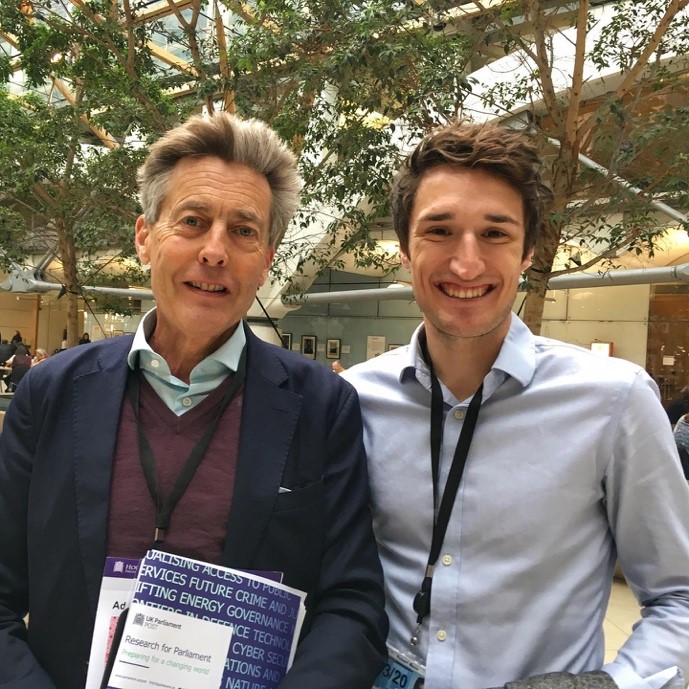
    • You get to work on behalf of Parliament: One of the more obvious reasons to apply for a Fellowship at POST is the opportunity to work on behalf of Parliament. In the first few weeks this will be represented by your unique position of being able to watch political debate, quench your thirst at one of the Palace of Westminster bars, and start playing a game of MP “I Spy”. Most POST Fellows try to arrange a meeting with their local MP during their time in Westminster too. As shown in the photo, I was able to meet Ben Bradshaw (MP for Exeter) at Portcullis House.  Alongside this access, working on behalf of Parliament comes with the responsibility of making sure that the POSTnote is fully representative of the given topic area. As the initial target audience of a POSTnote is MPs and Peers, you need to be confident that the experts that were interviewed largely support the final document and agree that it as an accurate portrayal of the topic area. Much like having to respond to reviewer comments when submitting a journal article, the POSTnote is subject to peer-review from the majority of these experts. Therefore, amending the POSTnote according to this review process is the most demanding elements of the Fellowship. Regardless, it definitely improves the final output and develops your ability to maintain an impartial writing style.     

    • Your output sits at the interface between research and policy: As a PhD student, it is typical to become academically pigeonholed. After three or four years of very specific research, you hope to come out the other side of the process with research that can be used to inform policy and develop other types of research impact. On the contrary, undertaking an internship at POST allows you to work directly at the interface between research and policy. The output of which – the POSTnote – is used to inform political debate around the topic, potentially leading to policy changes. Due to the way that topics are chosen by POST (i.e. decided by a committee that includes members of both the House of Commons and House of Lords), the work that you conduct will always be of current interest to MPs and Peers. This can either be in response to certain events, such as the recent rise in knife crime, or more of a ‘horizon scanning’ activity, such as identifying the potential challenges of an increased use of wind power in the UK. This puts you in a unique position and one that teaches you a lot about how Parliament and Government uses research to influence its policy agenda. In turn, this experience can be used to develop your own knowledge about how to best use your PhD research to inform the research-policy interface.

    I hope that these points have given some insight into my time at POST and encourage you to apply too. While my time at POST was demanding, it was also nothing but rewarding. If you are considering applying yourself, don’t hesitate to get in contact with me.   

    Robert Mann is a SWDTP Health and Wellbeing PhD candidate at the University of Exeter. You can read more about his research on our Health and Wellbeing Student Profile page.

  • SWDTP Student Reps Meeting: 10 December 2019

    Chair: Jude Hill (Interim SWDTP Collaboration Facilitator)

    In attendance: Chris Gray (Bristol), Catherine Kelly (Bristol), Callum Cockbill (Bath), Maite Klein (Bristol), Fida Adra (Exeter), Nicole Russel Pascaul (skype) (Exeter), William Feltham (Bristol), Mike Rogerson (Bath) Nasrul Ismail (UWE), Daniel Lombard (Bristol), Nick Gray (Bristol), Suzanne Van Even (UWE), Connor Scott (SWDTP), Helen Stanton (SWDTP)  Apologies: Celia Robbins (Exeter), Maike Klein (Bath), Victoria Christodoulides (Bath)

    Items discussed

    Welcome and Introductions

    This was a first meeting for Nick Gray, Nicole Russel Pascaul, William Feltham, Suzanne Van Even, and Helen Stanton, who were welcomed to the group.

    Chair’s Business- Information on the SWDTP Student Focus Groups

    SWDTP has recently taken part in a mid-term review. Feedback is due to be received from ESRC by Christmas

    It was decided that a discussion should take place in the next student rep meeting about the feedback from the review and discuss whether there are agendas which the student reps can help with.

    New Director: With Sally Barnes’ imminent retirement interviews have been held for a new interim director this week. The outcome will be communicated asap.

    Membership Updates and Succession Planning:

    • Current numbers of student reps include: 6 Bristol, 4 Bath, 2 UWE and 3 Exeter, there are currently no student reps for Plymouth

    Round table for updates and issues raised to reps

    • Many students find the transition from the 1 to the +3 difficult. Similar issues also featured in the focus groups. Some suggestions about how help address these issues were discussed; student reps will be asked to feed into any plans for new student inductions in 2020 which may include a ‘refresher’  event for transitioning students
    • Some students supervised between different institutions can find it difficult to access information about events and social occasions taking place across both their institutions. SWDTP colleagues will consider how to address the issues raised.
    • Some problems with the SWDTP website forum have been encountered and solutions to address these were discussed.
    • The group discussed the potential value of running more collaborative cross-disciplinary seminar series to help better connect colleagues; Jude Hill will follow up by sending reps information about SWDTP funding opportunities that can be used to pay for such activities.
    • Reps provided points of feedback for the SWDTP conference organisers.

    Rep-Led Activities:

    • The reps discussed the potential to run regular informal meet ups for SWDTP students at Bristol and Exeter, along the lines of the weekly meet-ups at Bath.
    • Suzanne is arranging a New Year get together for UWE students
    • The reps were reminded that all events arranged can be advertised through the SWDTP

    Impact Fund

    Jude Hill noted changes that would be made to the impact fund form and guidance clarifying the process for ethics.

    Next Reps meeting

    Aiming for next March at UWE.

  • SWDTP Student Conference 2019 Recap

    SWDTP Student Conference 2019 Recap

    It’s been a month since Chris Shaw’s keynote speech closed the 2019 SWDTP Student Conference!

    I’d like to take a moment to thank everyone who made the day such a massive success, including:

    • The 150 people who attended this years conference, the SWDTP’s best ever attendance!
    • The 38 people who presented on their interests and research. We had such wide ranging topics from “Silent sex workers and secret knowledge: Communicating the unspeakable” to “Using polygenic scores to understand exposure to bullying” to “Lets talk about ducks”!
    • To Kelly Preece, Caitlin Knight, Tim Morris, Fiona Crawford and Professor Justin Dillon who presented riveting workshops, more information on which you can find below.
    • Also to Kelly Preece, Caitlin Knight and their student volunteers Maike Klein and Helen Foster Collins for their radio interviews providing a fantastic example of effective communication.
    • To Rob Freathy of the University of Exeter, who battled through technical difficulties to open the conference with a brilliant keynote speech on “Research, Researchers and Researching: Creating an Effective and Innovative Learning Environment”
    • To Chris Shaw, the Clerk of the Foreign Affairs Select Committee in the House of Commons, who gave a fantastic closing keynote speech on “Giving your research impact in policy making” as well as running a workshop on “Communicating research effectively with parliament”.


    You can find the programme from the day here:


    You can find slides from all of the Workshops and the two Keynote Speeches (you can now see Rob Freathy’s for the first time!) below:


    Now, only 11 months until the 2020 Conference in Bath!

  • Alisha Tuladhar Placement- The Innovation Beehive

    Back in the summer, Alisha Tuladhar had the opportunity to undertake a placement with The Innovation Beehive, a consultancy firm based in Cirencester. We asked Alisha a few questions about her placement and what she gained from it:

    Please give a summary of the placement and the work/activities you undertook.

    “My placement at The Innovation Beehive comprised of a range of activities. I attended various workshops, talks and presentations both internally and externally with the firms’ clients, for example: Two-days-Innovation Bootcamp Workshop at a client’s Head-Office in London, also had the opportunity to attend the Retail Week at Gloucester, attended several networking sessions in the Growth Hub and was part of the community on site.”

    Did the placement meet your original objectives and expectations? What were the tangible outputs or outcomes? Where there any unexpected outcomes or opportunities arising from the placement?

    “Yes, the placement met my original objectives and expectations. I initially had two major expectations: assisting the Consultant Head, on projects and using my research skills to help with the firms’ activities. I had expected my main job to be understanding the clients’ needs, analyse them and propose solutions that are customer-centric, technologically feasible and economically sound.

    These expectations were not only met, but in fact, surpassed. Since I was not only involved in client facing projects but also in the development of an internal training material for a large multi-national firm, it was a humbling experience for me to be working amongst an extremely knowledgeable team of consultants. This allowed me to gain an insight on how training materials were created and eventually enrolled in large MNCs.

    Moreover, again unexpectedly, I also got the opportunity to go to various events: some in London, some in Gloucester and was also invited to the Polo Club for a team outing. They were all tremendously valuable networking experiences.”

    How has the placement developed your insight into working with non-academic partners and the benefits and/or challenges of collaboration?

    “Indeed, there are a few differences whilst working with a non-academic partner. The first major difference was that the non-academic sector works in a pragmatic manner and is highly outcome-driven, rather than novelty-driven. In a PhD, we are often seeking for contribution to knowledge or are often
    truth-driven. Whereas, in a non-academic setting, it is more about outcomes and getting things done, rather than spending too much time on the foundational knowledge/ literature review.

    Second difference was the fact that there was very limited time allocated for research tasks. I think whilst doing a PhD or writing papers, the research component is lengthy and a time-consuming process, however with non-academic partners, the deadlines are stricter and tighter. There isn’t much time allocated for a deep-dive research. One needs to be extremely fast and proficient at their tasks.

    And the final difference is the number of stakeholders present.  I personally felt that whilst doing a PhD, its more about your supervisory team, which would be around 2-3, however, whilst during the placement, I was working with a larger team and had a lot of different moving parts. For example, in order to organize one event, there are clients, printing presses, designers, website, marketing communications hence it is more of a team effort with a smooth communication requirement. I personally found that in a PhD there aren’t too many stakeholders.”

    Has the experience of doing the placement made you think about the potential or the impact of your research differently? If so, how?

    “My experience at The Innovation Beehive has definitely shaped my thinking to be more wary of how my research might be applied, what value it brings to UK businesses. More specifically, I have realised that
    there is a lot of good research being done and published in Management Journals, however not many are read or known to business executives. I think the way forward needs to be more inclusive whereby the government, academia and businesses not only have access to research but also are conversing and sharing knowledge with each other. One way to ensure research impact is to publish in Open- Journals perhaps, this is something I personally will aim to do.”

    Are there opportunities for further collaboration with the organisation either for yourself, or for other students, in the future?

    “Yes, I think The Innovation Beehive team and founder, Mok, is very supportive towards students and the academic sector.
    In fact, Joe, the Innovation Director of the firm has already come to the University twice to record three academics for their Podcast. Hence, I think there is definitely more room for collaboration.”

    What advice would you give to a fellow student who is considering undertaking a placement?

    “My advice to a fellow placement student would be “listen, learn and be proactive”. I truly believe in the salience of being curious, asking the right questions, and making sure you are gaining the most of everything that your placement has to offer. Placement is a great opportunity to learn but you will only learn once you ask. So be courageous, be proactive and do your best.”

  • Alison Pearson- Cohort Building Fund

    Shut up and write sessions at St Luke’s, 2019

    As a PGR at the St Luke’s campus at the University of Exeter I had noticed that not many events and activities happen here – if you are lucky you bump into a colleague in the café or library, but it can leave you feeling a bit isolated.

    When I heard about the SWDTP Cohort Building fund I thought this might be the ideal way of getting something off the ground here – I know that people are busy, so I thought it would be good to find a way of combining social support with getting some work done. By chance I had recently heard about the “shut up and write” concept via some online communities, and so put forward a proposal to the SWDTP to fund a series of “shut up and write” events – the idea being to use the funding for refreshments to have at the end of the sessions to encourage people to stay on and develop those important informal social networks.

    With great thanks to the SWDTP for their support we managed to run a total of 23 sessions – and to have an event most weeks between January and July. The sessions evolved over this time – we found that the format that we liked the best was to have 3 writing bursts of 25 minutes each (with very short comfort breaks in between) and then to finish with coffee and cake. We had enough budget to finish with lunch every few weeks which added to the social feel and encouraged lots of productive writing – and good attendance!

    The only challenges really were working out how to order catering and getting a budget code set up, and deciding how best to promote the events. This was easily solved by setting up the events on Eventbrite and asking for these links to be included on internal emails and newsletters both at Exeter and through the SWDTP. Our biggest event was our first lunch, with 16 people: most weeks we had 8-10 people and it was great to get to know people at different stages of their PGR journeys and from different subject disciplines.

    There is something about writing in the company of others than creates a focussed and disciplined approach to your writing, as expressed by some of the attendees:

    “ I really appreciate these sessions because they help me focus on my writing. Additionally working in a quiet environment helps me produce good quality pieces of writing. It’s good to set a goal and then come to these sessions and achieve it!”

    “The shut up and write sessions have been great for me. I am a part time PhD researcher and spend most of my time at home working on my own. I find the sessions helpful in bringing a focus to my work – both while I’m in the room and also in advance in getting something ready to write. Also great to have some social contact and to share some of the stresses of PhD life. Really useful focussed and purposeful atmosphere.”

    “I have found these sessions invaluable for providing protective time for writing as well as peer support. Its really helpful to timetable/ provide structure for my week. The refreshments have supported networking. I have made huge amounts of progress by using these groups.”

    Thank you SWDTP for your support,

    Alison Pearson

    Year 2 PhD Student (University of Exeter)

  • Student Conference: October Update from the Chair

    St Lukes Campus Image
    St Lukes Campus, Exeter

    SWDTP Student Conference 2019

    Effective and Innovative Communication of your Research

    Wednesday 13th November 2019 
    University of Exeter, St Luke’s Campus

    Dear SWDTP Students,

    It’s been a while since you have had an update from the committee and the work we have been doing for the conference in little under a month away.

    Let me tell you where we are at the moment. There is a lot to take in… here we go:

    –  Abstracts: We have had an overwhelming number of abstracts submitted this year. We have now informed all those who have been successful and those were not successful this time. The quality of the abstracts were great but due to time and space we had to reject some based on the three reviewers scores. If you submitted an abstracts and haven’t heard from us then please do let us now.

    –  Posters: We have had a great number of posters that have been submitted so far. You do not have to register first and can bring posters on the day. However, registering means that we can reserve you a space.

    –  Workshops: We have at least 6 workshops happening throughout the day around the theme of communication. These workshops are not bookable in advance and are only bookable on the day. When you register and collect your credentials you will also then be able to head over to the ‘Workshop Registration Desk’ and pick 1 or 2 workshops you are interested in attending. This will based on a first come first serve basis.

    –  Keynote Speakers: We are delighted to announce that our two keynote speakers have all been confirmed. In the morning, Professor Rob Freathy from University of Exeter will be giving his address. At close of conference, Chris Shaw who is the Clerk in the House of Commons will be delivering his address.

    –  Catering: We have a great local caterer (Birch Catering) who will be supplying this year’s food and refreshments. There will be unlimited tea and fresh filter coffee all day along with orange and apple juice and a delicious buffet in the afternoon for lunch.  Birch Catering will also be making fresh sandwiches and snacks with ant left over ingredients to donate to a local homeless charity.

    –  Reusable Cups/Water bottles: If you have a reusable cup or water bottle then please bring it with you so that we can contribute towards sustainability. If you don’t have one, don’t worry, paper cups will be provided.

    –  Drinks Reception: We have put on a really nice drinks reception at the end of the conference serving both soft and alcoholic drinks. There will also be bar snacks and Canapes served.

    –  Coach Travel: For those of you coming from Bath and Bristol, please don’t forget that there are railway works between Bristol Temple Meads and Exeter St David’s on the day of the conference. The SWDTP Conference Committee and the SWDTP team in Bristol have worked hard to try and sort this out. We have now been able to put on a FREE and DIRECT coach service from Bristol Tempe Meads straight to St Luke’s campus. The time this takes works out to be roughly the same time it would be to travel by train to Exeter St David’s and either walk or get a bus shuttle to St Luke’s. You should have received details of this from the committee. If you haven’t please let us know and we will send the information to you. Please note that spaces are filing quickly and we only have 63 spaces.

    –   Timetables and Programme: We are still working on the timetable and programme and the next stage for us is to look at themes from the abstracts. We have already placed papers into some themes and the committee will be looking at this in our next committee meeting. Programmes will be available online and you will also receive one in your conference pack when you register.  

    –   Stalls and Pop-up shops: We have invited Blackwell’s the book shop to this year’s conference who will be setting up a pop-up shop. They will be selling wide selection of books relating to PhD study. They will also be offering various discounts so please visit them in our ‘Pop-up SWDTP Café’. We will also be hosting some stands from various groups and organisations, so please visit them and say ‘hi’.

    I hope this gives you an idea of where we are up to. I would also like to take this opportunity to thank all of the committee members for their hard work. The committee members have put in a huge amount of hours so far into planning this and a lot of hours into travelling around the partnership institutions. The committee are not paid to do this and it is completely voluntary. There have been some challenges faced with room bookings, travel from Bristol and Bath and timetabling, all of which have been overcome due to the dedicated hard working conference committee. If you see any of the committee during the conference, please say hi to them and thank them for all their hard work! 

    Best wishes

    Warren

    Warren Speed
    Chair of SWDTP 2019 Conference