Category: SWDTP

  • The SWDTP’s First Summer School at Bailbrook House

    The SWDTP’s First Summer School at Bailbrook House


    On a quiet Wednesday morning in Bath, the first SWDTP summer school began. Students travelled from across the South West to Bailbrook House in Bath for a three day immersive experience in collaboration, employability and wellbeing that aimed to provide insights and techniques to use now and in the future. We had 44 students in total, including 14 PGRs not funded by the SWDTP, with every stage of the PhD journey represented from MRes to writing up.

    The aim of the event was to guide students through the three themes while also having the opportunity for networking and quiet moments for reflection.


    Mind the Gap wellbeing session

    Close the wellbeing knowing-doing gap with solution focused reflection with Abi Boughton-Thomas, Wellbeing Coach

    • Abi Boughton-Thomas helped students theorise wellbeing and encouraged attendees to discuss with others how it impacts yourself as a researcher.
    • Abi used a compassion-based approach to explain why we need self-compassion and how this changes under stress. One question that regularly came up was: Is our perfectionism being directed in the wrong way? How do we find a happy medium between attention to detail and *obsessive* attention to detail?
    • At the end of the session, students were asked to identify key learnings from the session and stick to the board. There were many common points, showing how the PhD journey is universal despite feeling isolating.

    Top tips from a former SWDTP student

    We also heard from Nasrul Ismail, Lecturer in Criminology, University of Bristol and former SWDTP student talking about his tips for making the most out of your PhD and beyond. His top tips included:

    • When considering how to forge your own path, the best places to focus on are collaboration and your own branding
    • Resilience takes practice so it’s important to remember that just like Formula1, you need pit stops – and not just when you’re burnt out! Finding a work life balance that works for you will stop you from being consumed by your research – try and find a hobby outside of your PhD. Most importantly, ask for help when you need it – sometimes it can be the best thing for you.
    • When it comes to publishing during your PhD, focus on quality over quantity
    • Nasrul also gave some insight into his viva: Because he had published work on some of his chapters during his PhD, his viva questions were much more focused and easier to manage

    What our students said

    The SWDTP summer school was a brilliant networking opportunity, that also helped me develop my skills and identity as a researcher

    Hannah cowdell

    This summer school made me realise how wonderful and supportive the SWDTP community is

    Ella Barclay

    This was a fantastic summer school at a great venue and has given me plenty to think about when working with other disciplines and managing my wellbeing

    Josh Tenn

    I found a great community of doctoral researchers from whom I learnt so much in a supportive environment. The summer school promoted these fantastic experiences through creative methodologies in a great location.

    Silvia Espinal Meza
  • Black Future Dr: A Podcast Increasing the Visibility of the Black Doctoral Experience

    Black Future Dr: A Podcast Increasing the Visibility of the Black Doctoral Experience

    Racial inequality is a prominent issue in the UK, and this extends into education.

    Black future dr featured image. Image Description: A Black student sitting outside on campus

    We can see this gap at an undergraduate level, with a 22.6% difference between white and black African-Caribbean students receiving a 2:1 degree or above.

    We also see this gap at postgraduate level, with black and minority ethnic students being far less likely to go on to higher research degrees, such as PhDs and professional doctorates, than white students. In fact, in 2020, only 18.1% of research postgraduate students identified as black or minority ethnic.

    Despite these statistics, there is a growing community of black students pursuing doctorates in the UK. To increase our visibility and celebrate our achievements, Black Future Dr has been developed.

    Black Future Dr is an upcoming podcast, funded by the SWDTP’s Impact Fund and dedicated to showcasing the experiences of black doctoral students in the UK. This includes PhD students, as well as students doing professional and medical doctorates. There will be 12 episodes in total, with each focusing on a different student studying a different subject at a different institution. Each episode will be 20 minutes long and will be hosted by Nina Higson-Sweeney (@n_higsonsweeney), a SWDTP-funded PhD student at the University of Bath. We will be discussing a variety of topics, including supervision, motivation, mentorship and non-traditional pathways.

    Episodes will be released weekly starting from Monday 3rd May 2021 and can be listened to via Acast as well as on Spotify, Apple Podcasts, Google Podcasts, and Deezer.

    Current guest speakers for the podcast include:

    • Lateesha Osbourne, a final-year PhD student in Psychology at the University of Bath
    • Rees Johnson, a third-year PhD student in Law at the University of Manchester
    • Adewale Kukoyi, a second-year student studying for a professional doctorate in medicine at the University of Bristol
    • Alanah Mortlock, a second-year PhD student in Gender Studies at the London School of Economics
    • Emmanuel Johnson, a third-year PhD student in Education at Coventry University
    • Louisa Brotherson, a third-year PhD student in Earth Sciences at the University of Liverpool
    • Dave Mankhokwe Namusanya, a second-year PhD student in Sociology at Abertay University

    With 5 more guests to be announced!

    To keep up to date with the podcast, follow @BlackFutureDr on Twitter or subscribe to the podcast on your chosen platform.

  • Make Space: Panel Discussion: LGBTQ+ Experiences of Mental Health and Self-Harm


    People who identify as LGBTQ+ are often at the sharp edge of social inequalities, often facing disadvantage throughout a range of social systems. While there are conversations happening about LGBTQ+ mental health, we do not believe they adequately explore (a) the systemic issues faced by the LGBTQ+ communities (b) the intersection of being both LGBTQ+ and someone with experience of self-harm. In this panel discussion, we seek to give space and time to the ways in which we might think about and experience self-harm and mental health in relation to queerness.

    Facilitated by Make Space (makespaceco.org), an organisation co-founded by SWDTP Student Courtney Sommer, panellists will present their own perspectives on the topic, and will also engage in broader discussion, responding to questions from attendees. The panel brings together a number of exciting speakers, who will provide vital, nuanced perspectives.

    Speakers include:  

    • Nim Ralph (they/them) – trans rights activist and freelance writer, trainer, and facilitator

    • Ginny Russel (she/her) – interdisciplinary Senior Lecturer in mental health at the University of Exeter

    • Tamara-Jade Kaz (she/her) – queer black creative facilitator and trainer based in London.

    • Beth Ingram (she/they) – founder of youth peer support charity Hearts & Minds

    • Max Cohen (he/him) – counsellor, trainer and group facilitator based in Exeter.


    This event is part of a wider program of events focussed exploring LGBTQ+ self-harm.

  • ‘Decolonization is not a metaphor’

    ‘Decolonization is not a metaphor’

    Suzanne van Even and Zibah A. Nwako

    Suzanne van Even and Zibah A. Nwako discuss the first session in our Decolonising Social Research Series: Decolonising Theory.

    On Thursday 19 November 2020, the SWDTP’s ‘Decolonising Social Research’ series launched with a provocative seminar on Decolonising Theory with speakers Foluke Adebisi (Senior Lecturer in Law, University of Bristol), Mark Jackson (Senior Lecturer in Postcolonial Geographies, University of Bristol) and Arathi Sriprakash (Professor of Education, University of Bristol).

    This seminar series came at an opportune time. As doctoral researchers in the Social Sciences ourselves, we find it very important to engage with decolonial critiques and the decolonisation literature more generally. It is of particular importance in the context of co-creation of knowledge whereby social researchers, like us, work closely with participants, community stakeholders and policymakers. For us both, our research seeks change and impact – not just to engage in knowledge translation, but also with the aim of emancipating and empowering knowledge producers and knowledge receivers, respectively.

    Foluke’s presentation, Rhodes Must Fall, or Rhodes Must Read More Fanon? (title inspired by a tweet by @fanoniscanon), considered what we mean when we talk about decolonising theory. Are we trying to unsettle the concepts that are the foundational presumptions of our discipline(s) or are we leaving those as they are? Do we add in other concepts which will never reach the eminence of the foundational concepts that we hold dear?

    Foluke reflected on how diversifying literature relates to decolonial thought. She argued that there is a difference between including ‘diverse literatures’ (in our research) and decolonial thought. She posited that a major distinction between decolonial thought and diversity is that the latter makes no distinction between epistemic and embodied difference.

    Using a table as a metaphor (the table representing colonised space), Foluke briefly discussed the four main schools of decolonial thought:

    1. Settler states (Americas, Australasia, South Africa) – part of the table does not belong to you, can you give it back to us?
    2. Post-colonial states (Africa and Asia) – well, that’s a nice table, can we join you there?
    3. Latin American critical school (Latin America and Caribbean) – is that really a table? What is it meant for? Should we destroy it and think of a table in a different way?
    4. Colonising states – this category of thought is often not mentioned, because some argue that you cannot decolonise empire (Tundama, 2016).

    Finally, Foluke questioned what decolonial research can possibly do? Referring to Escobar (2018), hooks (1991), and Mignolo (2016), she contemplated whether decolonising theory can be liberatory.

    Mark’s presentation on Decolonizing Theory: Perspectives from Geographies focused on how to reverse the centre-periphery relationship. He questioned whether the vocabularies, categories of thought, and concepts employed by normative social science are suitable and effective means for making sense in, or of, non-Western worlds?

    Although 80% of the world is located outside of Europe, European thought (processes) define our view of the world. Yet, non-Western worlds do not use European concepts such as ‘gender’ and colonised notions of ‘nations’. Mark suggested that decolonial critique attempts to unsettle this – by turning Eurocentric assumptions and concepts on their heads.

    As researchers, we take people’s lived experiences and transpose them through pre-conceived categories, thereby assimilating them into terms that can then be put to work. We argue that as a result of this, knowledge is formed. Mark postulated that this process of identification, extraction, re-purposing and circulation is a form of commodification.

    Mark posited further that there are four main implications for decolonising theory:

    1. Need to enable theorising from the outside.
    2. Give up on the idea of a universal standard and instead embrace ‘pluriversality’ of epistemologies and ontologies (Escobar, 2018).
    3. Regard the decolonial as an option (Mignolo, 2011; Murrey, 2019; Nigam, 2020). It is not a particularly privileged mode of deriving theory but provides a range of possible strategies (Nigam, 2020) that might allow for a necessary preliminary step to reconstitution.
    4. Theorising well is fundamentally about fostering caring. In order to know, you need to care (Dalmiya, 2016).

    In her presentation titled Decolonising Theory: The erasures of racism in education and international development, Arathi asserted that we need to ask questions of the theories that we use.  Moreover, she warned us against superficially adopting the term ‘decolonisation’ as it has become a bit of a buzz word. The aim of decolonisation is to unsettle power relations, in real and material ways. Decolonisation should bring about the repatriation of indigenous land and life; it is not a metaphor for other things that we want to do to improve our societies (Tuck and Yang, 2012). Using decolonisation as a metaphor, keeps colonial structures in place.

    Arathi argued that it is important to decolonise theory because it doesn’t just operate at an abstract level. Instead, theory emerges from lived experiences that shape how we act and intervene in the world in profound and concrete ways. Theories of development, and specifically theories of modernisation, have worked to divide the world into categories such as ‘developed’, ‘developing’, ‘traditional’ and ‘modern’. This entrenches the idea that people and places need to ‘catch up’, as if they were developmentally backwards. This type of theorising that persists today is based on a deficit model, positioning the problem of poverty with racialised and colonised people and their practices. In doing so, it secures primarily European and Anglo-American epistemologies, industries and interventions as valid and good, forming the material effects of epistemic injustice. In education, this colonial way of thinking makes educational inequality irrelevant whilst it is, in fact, profoundly relevant for understanding educational injustices (e.g. Mills, 2007, ‘epistemologies of white ignorance’).

    Arathi ended her presentation with a reading of Abhay Xaxa’s (2011) powerful poem “I am not your data”, reflecting Tuhawai Smith’s (2012) words that “’research’ is probably one of the dirtiest words in the indigenous world’s vocabulary” (pp. 1).

    The presentations resulted in thought-provoking discussions, indicating from this first seminar that there are still a lot of questions to be answered. For example, can we decolonise theory without de-colonising theory? Foluke posited that even after years of decolonising theory – colonial theory is still dominant. When we think about neo-liberal constructions, we are more likely to find validation for decolonising theory than using theory that decolonises. The danger is that we take the path of least resistance. So, it is always important to point out that this is not the destination, this is not where we are headed. Even if we are trying to be more inclusive in our decolonising of theory, we are not just doing that because it is a good thing to do. We are doing it because it brings about a new world. And as social researchers, this is the change and the impact that we seek to achieve through decolonising theory!

    The audio-visual recording of the Decolonising Theory session can be watched here: https://t.co/RDVWf7thyT

    Suzanne van Even is a PhD student at UWE in Bristol. Her research explores how people of African Caribbean and African ancestry cope with mood disorders associated with having an autoimmune rheumatic disease. Suzanne originally trained as a solicitor in the Netherlands before working as a fundraiser for arts charities in both the Netherlands and the UK. She is now retraining as a psychologist. Suzanne’s research interests include the mental health and wellbeing of African and African Caribbean men and women, community-based research and creative research methods. Twitter: @SvanEven77 

    Zibah A. Nwako completed her PhD at the School of Education, University of Bristol. Her thesis is titled ‘In Our Own Voices: A Critical Participatory Study of the Wellbeing of Female Undergraduate Students in Nigeria’ and she researched this topic using a postcolonial feminist lens. Zibah is a speaker, trainer and consultant on women’s personal development and gender justice. Her research interests include the personal welfare and wellbeing of girls in Africa, non-formal education and informal learning, qualitative research methodologies and creative methods. Visit her website and blog here: www.zibahnwako.com

    For more information about the SWDTP’s ongoing ‘Decolonising Social Research Series: Click here.


    References

    Dalmiya, V. (2016). Caring to Know, Comparative Care Ethics, Feminist Epistemology, and the Mahãbhãrata. Oxford University Press.

    Escobar, A. (2018). Designs for the Pluriverse, Radical Interdependence, Autonomy and the Making of Worlds. Duke University Press.

    Escobar, A. (2018). ‘Farewell to Development’. Available from https://greattransition.org/publication/farewell-to-development

    hooks, b. (1991). Theory as liberatory practice. Yale JL & Feminism, 4, pp. 1.

    Mignolo, W. (2011). Epistemic Disobedience and the Decolonial Option: A Manifesto. Transmodernity, 1 (2), pp. 3-23.

    Mignolo, W.  (2016). The communal and the decolonial. Available from http://www.turbulence.org.uk/index.html@p=391.html

    Mills, C. (2007). White ignorance. Race and epistemologies of ignorance, 247, (Sullivan, S. & Tuana, N., Eds) pp. 26-31. State University of New York Press.

    Murrey, A. (2019). ‘When spider webs unit they can tie up a lion’. Anti-racism, decolonial options and theories from the South. In: Routledge Handbook of South-South Relations (Fiddian-Qasmiyeh, E. & Daley, P., Eds).

    Nigam, A. (2020). Decolonizing Theory, Thinking Across Traditions. Bloomsbury Publishing.

    Smith, L. T. (2012). Decolonizing methodologies: Research and indigenous peoples. Zed Books Ltd.

    Tuck, E. and Yang, K. W. (2012). Decolonization is not a metaphor. Decolonization: Indigeneity, Education & Society, 1 (1), pp. 1-40.

    Tundama, N. (2016). You cannot decolonise colonialism. Available from https://www.youtube.com/watch?v=hXJS8d2T1IE  

    Xaxa, A. F. (2016). I am not your data. Available from http://adivasiresurgence.com/2016/01/13/i-am-not-your-data/

  • SWDTP Christmas Party 2020!

    SWDTP Christmas Party 2020!

    SWDTP  Christmas Card Competition & Online Christmas Party

    Warren Speed and Elis Jones (both from the University of Exeter) are pleased to announce that we have secured SWDTP funding to host an Online Christmas Party and a ‘Research as a Christmas Card’ competition. We’re hoping this will be a good opportunity to get together as a group after a while apart, as well as have some fun and maybe a few drinks. We’re also keen to make it (a little bit) less virtual than the Zoom meetings we’ve been having this year – see details below.

    Research as a Christmas Card Competition

    This year we thought it might be some fun and festive for the SWDTP community to enter themselves into a competition designing a Christmas card in the theme of your own research interests (see poster attached). There are a few rules which are:

    1.       Cards should be Christmas themed and related loosely to your research interests

    2.       Cards can be in any format you like as long as the image is clear and can be sent by email.

    3.       Deadline to submit your entry is Tuesday 15th December 2020 at 5pm

    4.       All entries are to be submitted to w.speed@exeter.ac.uk (Include your institution and a maximum of 300 words giving your card some context).

    5.       A public vote will take place online from Wednesday 16th – Tuesday 22nd December 2020. The link will be emailed to attendees and sent via the SWDTP.

    6.       The winner will be announced on Wednesday 23rd December 2020.

    7.       If you have any questions contact Warren Speed (w.speed@exeter.ac.uk) or Elis Jones (erj205@exeter.ac.uk)

    SWDTP Online Christmas Party

    We can all relate to how mundane online meetings and events can sometimes be. Myself and Elis have tried to think of a way of how me could host an online event but bring it to life. To that end we will hosting a variety of mini competitions and events that will involve the things we will send out to you through the post in our SWDTP Christmas Party Pack (along with some extra goodies). As there is no way we can all physically meet, we thought that this would be a great way for us to have some festive fun (see poster attached). Some of the things we have planned are:

    ·         Christmas Playlist 

    ·         Christmas Jumper & Fancy Dress Competition

    ·         Christmas Themed Quiz 

    ·         Balloon Creation Competition

    ·         Virtual Christmas Photo Booth

    ·         Guess the Gift

    ·         Design your own gingerbread man avatar 

    ·         We will have different rooms available for those who want to chat etc.

    To sign up to the SWDTP Online Christmas Party please click here to access Eventbrite.

    We want to remain as inclusive as possible and we understand that some people would enjoy spectating and chatting. We have made plans to make sure that this is also possible and you will also be sent an ‘SWDTP Christmas Care Package’ without the games and props.

    So please come along and get involved and join us. We hope we can bring the SWDTP community together, have some fun, and support each other towards the end of this long year!

    Finally, we would both like to thank the Collaboration Facilitator, Sonja, Richard, Joanna, Helen and Jude from the SWDTP for all their support and hard work. We understand it has been incredibly challenging for you as it has been for all of us. We hope that you are all able to join us for the SWDTP Christmas Party.

    Best wishes

    Warren Speed and Elis Jones

    University of Exeter

  • Decolonising Social Research Seminar Series

    Decolonising Social Research Seminar Series

    Social research has been complicit in slavery, colonialism and racism, in ways that are more and less visible. Social research has also contributed towards antiracist and decolonising movements and activitism. This SWDTP funded seminar series will explore theoretical and methodological tools for conducting research that is antiracist and decolonising. It will look at how we design and conduct research that disrupts established power relations within research, including those between researcher and researched, expert and novice.

    Decolonising Theory 19th November 2020 2-4pm

    Speakers: Foluke Adebisi, Mark Jackson and Arathi Sriprakash (all University of Bristol)

    When it comes to conceptualising a research problem, we often turn to literature and pre-existing theoretical frameworks. The social sciences grew up alongside the European project of world domination and competition through colonisation. Hence, much of the established canon of disciplinary knowledge has contributed to the imperial project of colonisation and contemporary relations of oppression. On the other hand, scholarship resisting and opposing colonisation also has a long and deep history including scholars identifying with marginalised and oppressed racial groups in the Global North and scholars form the global South.

    This session will examine what it could mean when we talk about decolonising theory. Does it mean different things in different disciplines? How do we reconcile the co-optation of decolonising within the agenda of HE with our various understandings of decolonial thought? What questions of praxis arise when we apply decolonial thought to theorising?

    Click here to sign up!


    The Decolonising Social Research seminar series is for doctoral researchers (and their supervisors) at any and every stage of the doctoral journey, who aspire for their research to contribute towards decolonisation in any space or form. Through the short series of events, we aim to stimulate debate around the tough questions that decolonisation poses for social research, to forge supportive networks across universities of the South West and to signpost readings and resources. Across the series, we will engage with the work of established scholars who have published on different aspects of decolonising research, the ideas and experiences of early career researchers, as well as representatives of marginalised groups, whose knowledge has historically been excluded from the academy.

    For each seminar, we will provide recommended reading for those wishing to explore the issues raised further. The seminars will take place as a webinar via Zoom. On registration, participants will receive an email with the Zoom link and recommended reading for the seminar.

    Forthcoming seminars in the series:

    Decolonising epistemology 26th November 2020 2-4 pm

    Decolonising methodology 14th January 2021 2-4pm

    Decolonising research ethics TBC

    Decolonising writing and representation – 21st January 2020 2-4pm

  • Join the 2020 SWDTP Conference Committee!

    Join the 2020 SWDTP Conference Committee!

    The SWDTP Conference 2020 will be held in Bath in November (date and venue to be announced). However, planning this event will start in early spring!  

    The annual SWDTP conference is a conference organised for students by students. Think you’ve got what it takes to conceptualise, organise and run a successful conference?  Well, we are looking for enthusiastic and committed people to organise this years event.

    The conference is free of charge and is open to all PGR students across the five SWDTP institutions, regardless of funding source.  It is a great way to get conference presentation experience and meet other students, who are at different stages of their research, to share ideas and details of projects, plans and experiences.

    More importantly,  for the organising committee, it presents a fantastic skills development opportunity in devising, developing, planning, organising and hosting an academic conference in a collaborative and supportive setting. There are a whole raft of things to get involved in from reviewing abstracts and finding keynote speakers, to creating posters and  booklets, running social media and booking facilities and  not forgetting the most important element of any conference, ordering the sandwiches!

    Want to be involved? Got burning ideas for themes or topics?  Got an eye for detail or a flair for organising? Then don’t delay, we want to hear from you today!

    Contact Jo (joanna.williams@bristol.ac.uk) to find out more and join the committee to start shaping this years conference.  

    We look forward to hearing  from you.

    For inspiration: find out more about the 2019 conference here.

  • Robert Mann – POST Policy Internship

    Robert Mann – POST Policy Internship

    Robert Mann recently undertook a three-month research fellowship with the Parliamentary Office of Science and Technology (POST). Here he outlines his experience and why you should consider applying too:

    I have recently completed a three-month fellowship at the Parliamentary Office of Science and Technology (POST), as part of my PhD. This opportunity was made available through the UK Research and Innovation policy internship scheme, supported by the Economic and Social Research Council.

    Robert Mann Post Fellowship Photo

    POST is Parliament’s in-house source of independent, balanced and accessible analysis of public-policy issues related to science and technology. As a bicameral office, POST works on behalf of both the House of Commons and the House of Lords. Having been founded in 1989, POST largely focuses on writing four-page briefings, known as POSTnotes. These briefings are impartial, non-partisan, and peer reviewed. During my fellowship, I was tasked with writing a POSTnote on the topic of ‘non-custodial sentences’.


    As my POSTnote is unlikely to be published soon, largely due to the General Election, I thought that I would attempt to convey three reasons why you should consider applying to undertake a fellowship at POST during your PhD:


    • You will be forced out of your comfort zone: The process of writing a POSTnote is challenging, in the best possible way. Within three-months, you are required to scope the literature; contact and arrange interviews with topic experts (including academics, third sector organisations and Government departments), condense this information into a POSTnote, before amending this work according to internal and external review comments. The difficult part of this is that your POSTnote topic does not always relate to your PhD research. Therefore, you are required to learn about a new topic and work at a pace that allows you to maintain balance and accuracy in your written work, without feeling too much like an impostor. Although this task can seem somewhat unsurmountable, it reinforces good practice for your PhD work, such as being able to manage a demanding workload and assessing the merits of research evidence. 

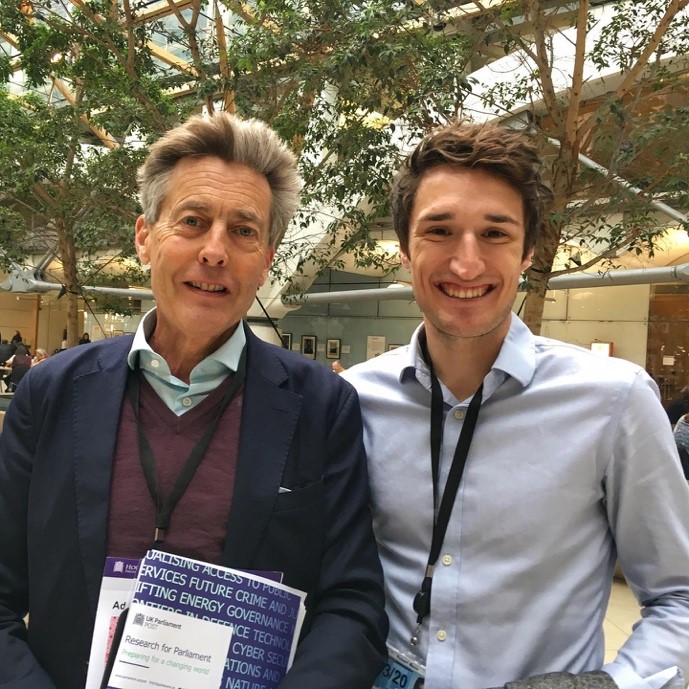
    • You get to work on behalf of Parliament: One of the more obvious reasons to apply for a Fellowship at POST is the opportunity to work on behalf of Parliament. In the first few weeks this will be represented by your unique position of being able to watch political debate, quench your thirst at one of the Palace of Westminster bars, and start playing a game of MP “I Spy”. Most POST Fellows try to arrange a meeting with their local MP during their time in Westminster too. As shown in the photo, I was able to meet Ben Bradshaw (MP for Exeter) at Portcullis House.  Alongside this access, working on behalf of Parliament comes with the responsibility of making sure that the POSTnote is fully representative of the given topic area. As the initial target audience of a POSTnote is MPs and Peers, you need to be confident that the experts that were interviewed largely support the final document and agree that it as an accurate portrayal of the topic area. Much like having to respond to reviewer comments when submitting a journal article, the POSTnote is subject to peer-review from the majority of these experts. Therefore, amending the POSTnote according to this review process is the most demanding elements of the Fellowship. Regardless, it definitely improves the final output and develops your ability to maintain an impartial writing style.     

    • Your output sits at the interface between research and policy: As a PhD student, it is typical to become academically pigeonholed. After three or four years of very specific research, you hope to come out the other side of the process with research that can be used to inform policy and develop other types of research impact. On the contrary, undertaking an internship at POST allows you to work directly at the interface between research and policy. The output of which – the POSTnote – is used to inform political debate around the topic, potentially leading to policy changes. Due to the way that topics are chosen by POST (i.e. decided by a committee that includes members of both the House of Commons and House of Lords), the work that you conduct will always be of current interest to MPs and Peers. This can either be in response to certain events, such as the recent rise in knife crime, or more of a ‘horizon scanning’ activity, such as identifying the potential challenges of an increased use of wind power in the UK. This puts you in a unique position and one that teaches you a lot about how Parliament and Government uses research to influence its policy agenda. In turn, this experience can be used to develop your own knowledge about how to best use your PhD research to inform the research-policy interface.

    I hope that these points have given some insight into my time at POST and encourage you to apply too. While my time at POST was demanding, it was also nothing but rewarding. If you are considering applying yourself, don’t hesitate to get in contact with me.   

    Robert Mann is a SWDTP Health and Wellbeing PhD candidate at the University of Exeter. You can read more about his research on our Health and Wellbeing Student Profile page.

  • SWDTP Student Reps Meeting: 10 December 2019

    Chair: Jude Hill (Interim SWDTP Collaboration Facilitator)

    In attendance: Chris Gray (Bristol), Catherine Kelly (Bristol), Callum Cockbill (Bath), Maite Klein (Bristol), Fida Adra (Exeter), Nicole Russel Pascaul (skype) (Exeter), William Feltham (Bristol), Mike Rogerson (Bath) Nasrul Ismail (UWE), Daniel Lombard (Bristol), Nick Gray (Bristol), Suzanne Van Even (UWE), Connor Scott (SWDTP), Helen Stanton (SWDTP)  Apologies: Celia Robbins (Exeter), Maike Klein (Bath), Victoria Christodoulides (Bath)

    Items discussed

    Welcome and Introductions

    This was a first meeting for Nick Gray, Nicole Russel Pascaul, William Feltham, Suzanne Van Even, and Helen Stanton, who were welcomed to the group.

    Chair’s Business- Information on the SWDTP Student Focus Groups

    SWDTP has recently taken part in a mid-term review. Feedback is due to be received from ESRC by Christmas

    It was decided that a discussion should take place in the next student rep meeting about the feedback from the review and discuss whether there are agendas which the student reps can help with.

    New Director: With Sally Barnes’ imminent retirement interviews have been held for a new interim director this week. The outcome will be communicated asap.

    Membership Updates and Succession Planning:

    • Current numbers of student reps include: 6 Bristol, 4 Bath, 2 UWE and 3 Exeter, there are currently no student reps for Plymouth

    Round table for updates and issues raised to reps

    • Many students find the transition from the 1 to the +3 difficult. Similar issues also featured in the focus groups. Some suggestions about how help address these issues were discussed; student reps will be asked to feed into any plans for new student inductions in 2020 which may include a ‘refresher’  event for transitioning students
    • Some students supervised between different institutions can find it difficult to access information about events and social occasions taking place across both their institutions. SWDTP colleagues will consider how to address the issues raised.
    • Some problems with the SWDTP website forum have been encountered and solutions to address these were discussed.
    • The group discussed the potential value of running more collaborative cross-disciplinary seminar series to help better connect colleagues; Jude Hill will follow up by sending reps information about SWDTP funding opportunities that can be used to pay for such activities.
    • Reps provided points of feedback for the SWDTP conference organisers.

    Rep-Led Activities:

    • The reps discussed the potential to run regular informal meet ups for SWDTP students at Bristol and Exeter, along the lines of the weekly meet-ups at Bath.
    • Suzanne is arranging a New Year get together for UWE students
    • The reps were reminded that all events arranged can be advertised through the SWDTP

    Impact Fund

    Jude Hill noted changes that would be made to the impact fund form and guidance clarifying the process for ethics.

    Next Reps meeting

    Aiming for next March at UWE.

  • SWDTP Student Conference 2019 Recap

    SWDTP Student Conference 2019 Recap

    It’s been a month since Chris Shaw’s keynote speech closed the 2019 SWDTP Student Conference!

    I’d like to take a moment to thank everyone who made the day such a massive success, including:

    • The 150 people who attended this years conference, the SWDTP’s best ever attendance!
    • The 38 people who presented on their interests and research. We had such wide ranging topics from “Silent sex workers and secret knowledge: Communicating the unspeakable” to “Using polygenic scores to understand exposure to bullying” to “Lets talk about ducks”!
    • To Kelly Preece, Caitlin Knight, Tim Morris, Fiona Crawford and Professor Justin Dillon who presented riveting workshops, more information on which you can find below.
    • Also to Kelly Preece, Caitlin Knight and their student volunteers Maike Klein and Helen Foster Collins for their radio interviews providing a fantastic example of effective communication.
    • To Rob Freathy of the University of Exeter, who battled through technical difficulties to open the conference with a brilliant keynote speech on “Research, Researchers and Researching: Creating an Effective and Innovative Learning Environment”
    • To Chris Shaw, the Clerk of the Foreign Affairs Select Committee in the House of Commons, who gave a fantastic closing keynote speech on “Giving your research impact in policy making” as well as running a workshop on “Communicating research effectively with parliament”.


    You can find the programme from the day here:


    You can find slides from all of the Workshops and the two Keynote Speeches (you can now see Rob Freathy’s for the first time!) below:


    Now, only 11 months until the 2020 Conference in Bath!